The failure of a printed stone facade is almost never the print. It is the layout. Two hundred sheets of convincing marble read as wallpaper the moment they are fixed in a grid that ignores how stone flows. What follows closes that gap.
What "Stone Look" Means on a Cement Board
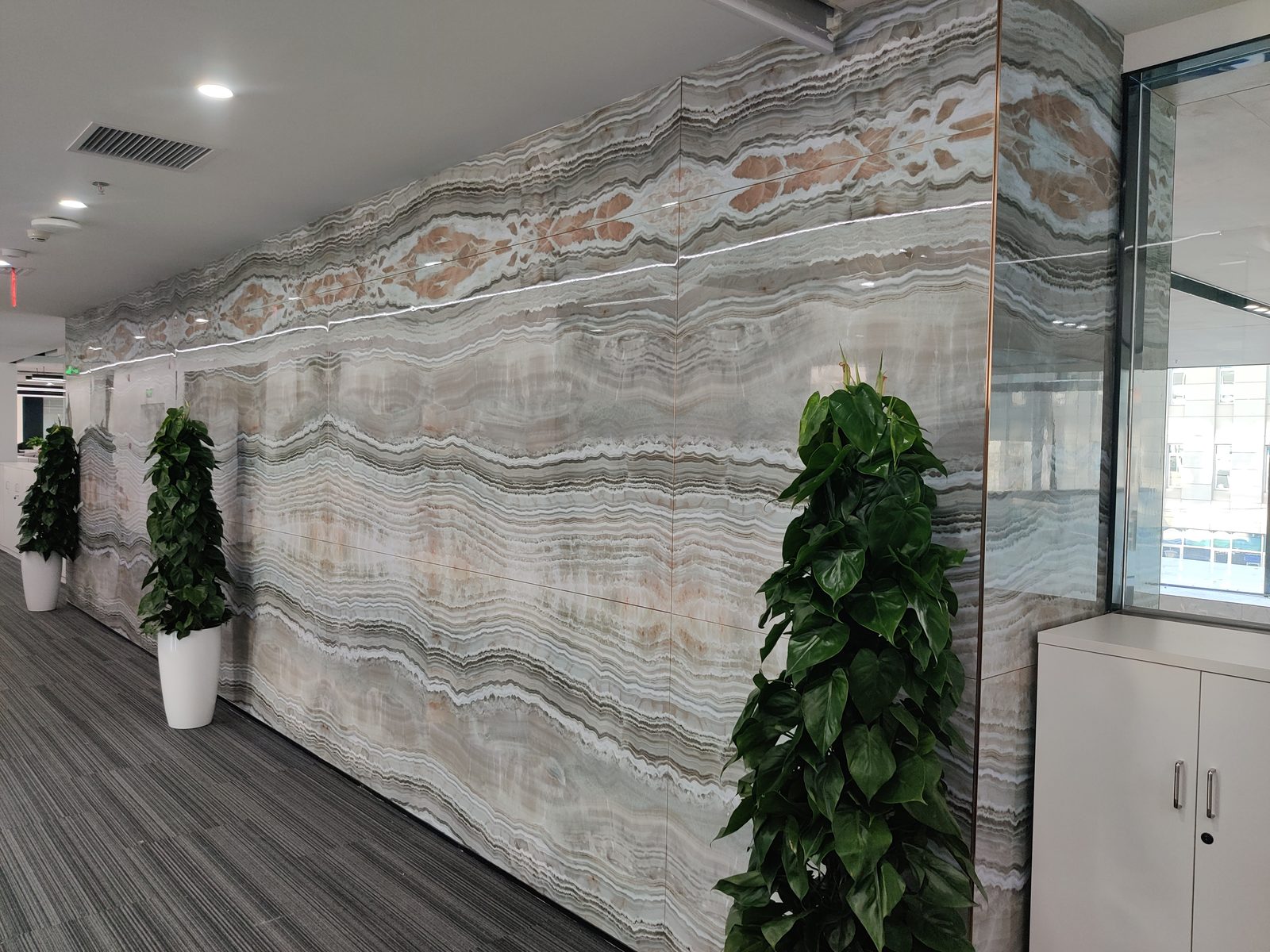
On a fiber cement board or a calcium silicate board the face is applied by UV-cured digital printing: the image is jetted onto the cured sheet, cured instantly under UV and sealed. It is not a paper laminate and not a vinyl film.
Because the ink sits on a mineral surface, sharpness depends on how flat it is. A wavy sheet prints a muddy vein, whatever the file resolution — which is why a printed cement board is printed on press-cured stock, not a bought-in blank, and why a decorative board is only ever as flat as the sheet beneath it.
The Board Under the Print Has to Be Facade Grade
An interior board is often specified at 0.65–0.85 g/cm³ to keep weight and handling easy. That is the right wall panel for a lobby. It is not automatically right for a west-facing elevation.
For an exterior stone look panel, insist on the supplier's facade grade: the denser sheet, typically a calcium silicate board or high-density fiber cement board. Check freeze–thaw (100 cycles, ≥80% strength retention) and swelling (≤0.25%) on the print's datasheet.
Three Ways to Lay Out a Vein
Stone is laid three ways; the drawing must name one.
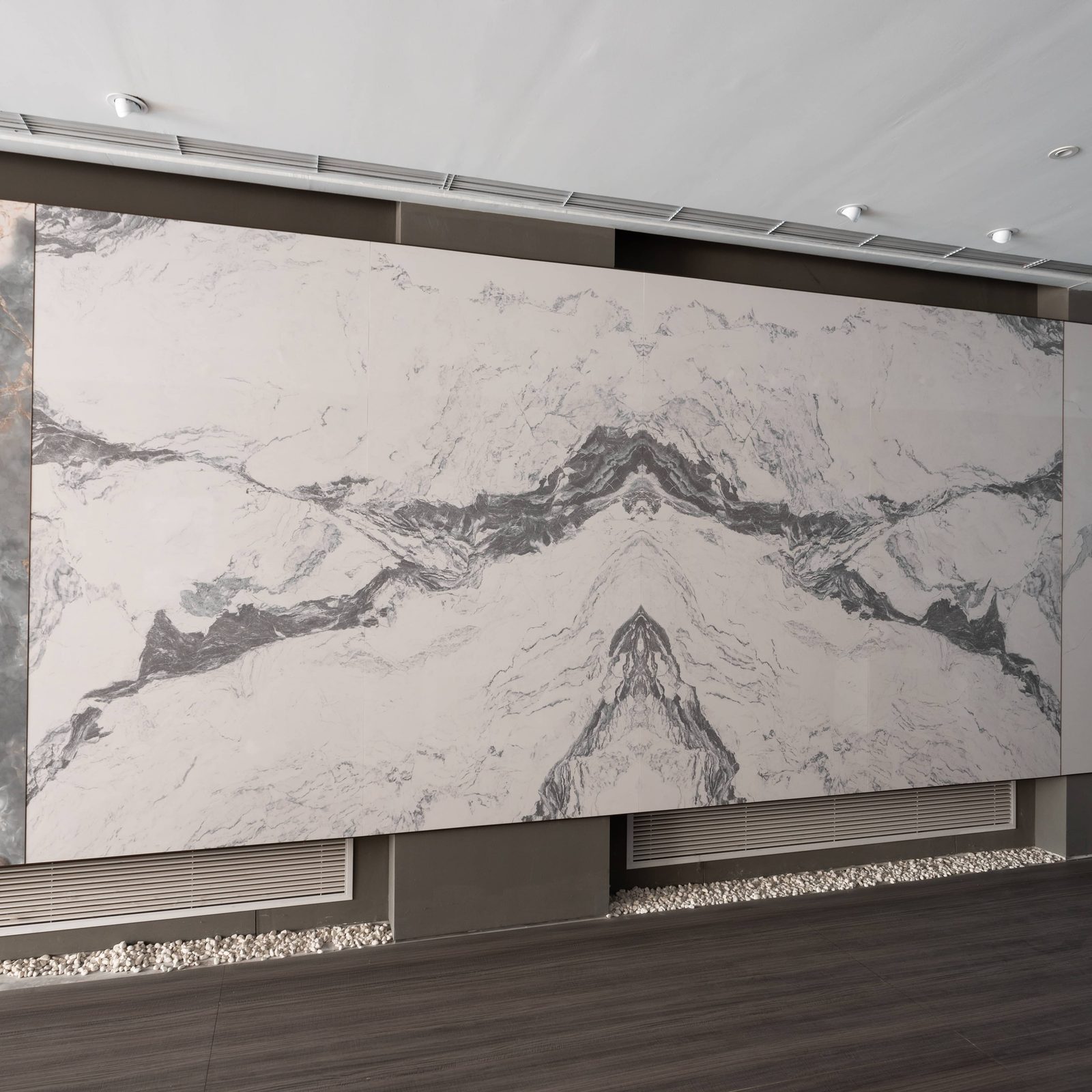
Vein-matched: consecutive panels continue the same vein, so a twelve-metre elevation reads as one block. Highest impact, no tolerance for error.
Book-matched: pairs mirrored about a joint — the butterfly of a marble lobby. Dramatic, and obvious when a pair is reversed on site.
Random: each panel independent. Forgiving, and the only sensible choice for a busy pattern at small scale.
Pick the mode first; every panel number follows.
The Print Layout Drawing
Each sheet carries one slice of a larger image, so the factory needs a panel map: which slice goes where, numbered to the elevation, with openings marked.
Keep the repeat unit longer than the viewing distance — a motif returning every 2.4 m is spotted from the pavement. Use the largest format the system allows: at 1220×2440 mm one sheet covers 2.98 m², and fewer joints mean fewer places for a vein to break.
Joints Are the Shadow Line
Stone reads as stone partly through shadow. A recessed joint or dark gasket gives the printed wall panel the same relief as dry-hung stone, and hides the tolerance you actually build to. Set the joint width on the drawing, run vertical joints with the dominant vein rather than across it, and let each vein end at a panel edge.
Frame, cavity and fixing pattern are in our external facade cladding guide; a printed panel changes the face, not the wall.
Openings and Corners Break the Pattern
Every window is where the image stops. Mark openings before the panel map is frozen, so the print is cut at the reveal rather than through a vein. Above an opening, align the horizontal vein with the returns on both sides, or the eye reads a step no print quality can hide.
At external corners use a purpose-made profile: a bare board edge is where water gets in, and our installation guide covers the sequence.
Batch, Spares and the Single-Panel Repair
Print runs vary slightly in tone. Order the whole elevation from one batch, and hold spares from it. Replacement is realistic because a stone look panel is printed: a damaged sheet is swapped, and a same-batch spare keeps the repair invisible. A later-batch spare shows at grazing light.
Weight and What It Buys the Structure
Weight per square metre is thickness times density: a 12 mm sheet at 1.3 g/cm³ works out near 16 kg/m². Confirm against the DoP, and never carry an interior low-density figure onto a facade. A 30 mm granite cladding is about five times that.
The saving shows in the sub-frame, the fixings and the scaffold time — and on a retrofit, in whether the wall needs strengthening at all. Sheet gauge against wind load is set in our thickness guide.
Where a Printed Stone Facade Is the Wrong Answer
Five honest limits. If the design wants real stone thickness at touchable height, print gives an image, not an edge. If the elevation carries extreme wind load on a rigid direct fix, the assembly needs engineering sign-off. If the wall is specified for mass, a light fiber cement board cannot supply it, as our acoustic guide sets out.
If the detail calls for deep carved relief, see carved cement board. And if the client is buying uniqueness, a repeatable print is not the offer.
The Specifier's Checklist
| Item | What goes on the drawing |
|---|---|
| Substrate | Facade-grade calcium silicate board or high-density fiber cement board; density stated on the DoP |
| Print layout | Mode named: vein-matched, book-matched or random; panel map numbered to the elevation |
| Format | Largest sheet the system allows; repeat unit longer than the viewing distance |
| Joints | Width and type stated; vertical joints following the dominant vein |
| Openings | Openings marked on the panel map before printing |
| Corners | Purpose-made profile; no exposed board edge |
| Batch | One print run of decorative board per elevation, plus spares from the same run |
| Fixing | System per the facade engineer; details in the cladding guide |
Frequently Asked Questions
Does a printed stone look panel fade outdoors?
The print is UV-cured and sealed, which is what makes it an exterior product at all. How long the colour holds depends on the coating and the exposure, so ask for the coating specification and the exterior terms in writing, not a shade card.
Can it be used as a rainscreen?
Yes — that is its main exterior use. A ventilated cavity keeps the back of the wall panel dry, and the fixing pattern is designed by the facade engineer for the wind load.
How do you match veins across panels?
By numbering panels on a layout drawing before anything is printed. Book-matched pairs are packed as pairs and marked left and right; vein-matched runs are sequential. Without one, the site invents its own layout and gets it wrong.
Can a single damaged panel be replaced?
Yes, provided the spare came from the same print run. This is the practical advantage of a printed decorative board over stone: a chipped sheet is a swap, not a re-cut from a block, and the joint line hides the seam.
Is the board non-combustible?
Reaction to fire is a material property: our boards are A1 to GB 8624 with AQ1 smoke toxicity, which does not change when a face is printed. Fire resistance of thirty, sixty or ninety minutes belongs to a tested assembly, so confirm the system in writing.
The Bottom Line
A stone look panel is a layout product before it is a print product. Get the substrate grade, the panel map, the joint line and the batch right, and the facade holds up at twenty metres and at arm's length. Get them wrong, and the best print in the catalogue still looks like a wall of wallpaper.
Comparing this against real stone? Our printed panel specification lists formats and finishes; the facade maintenance guide covers what the surface needs once up.