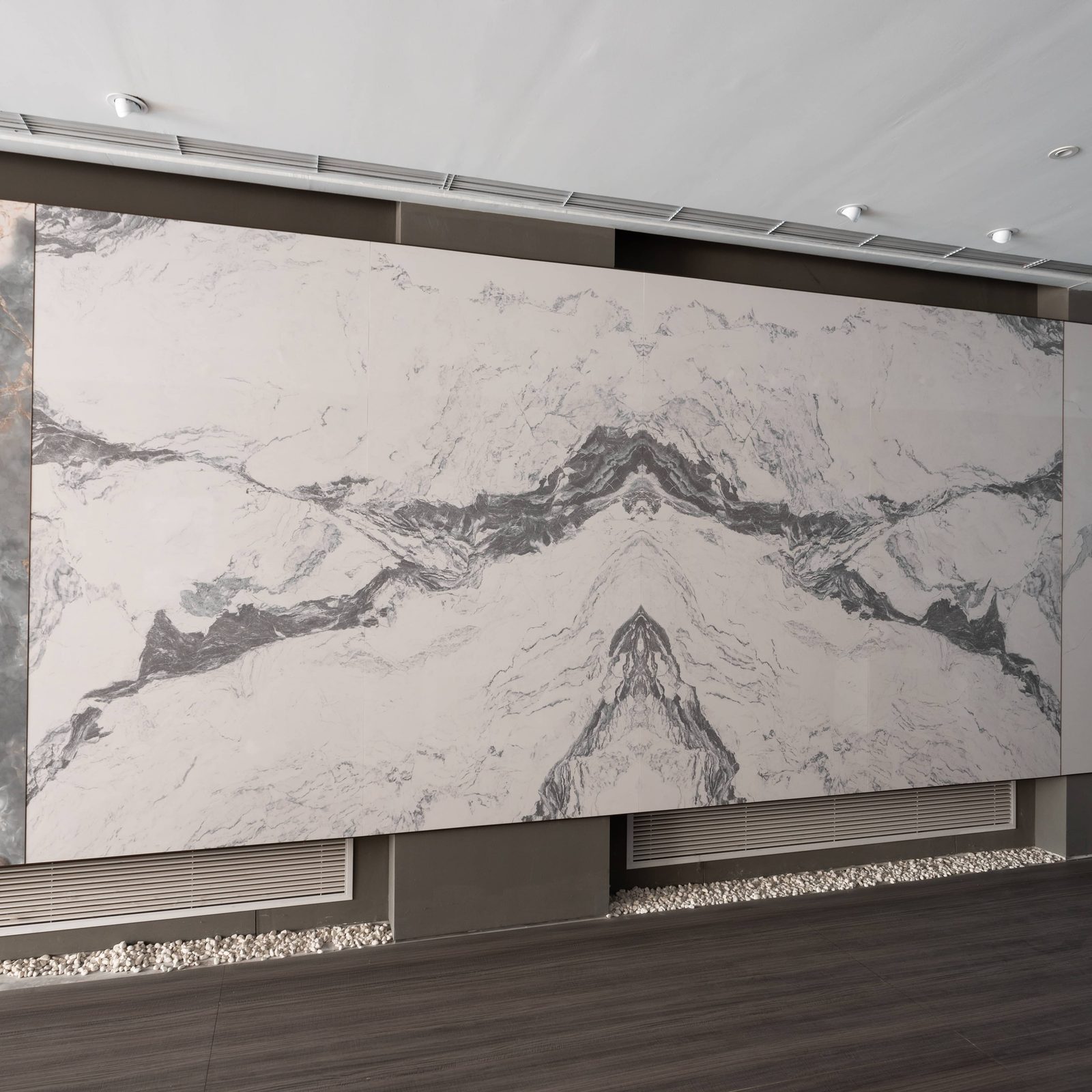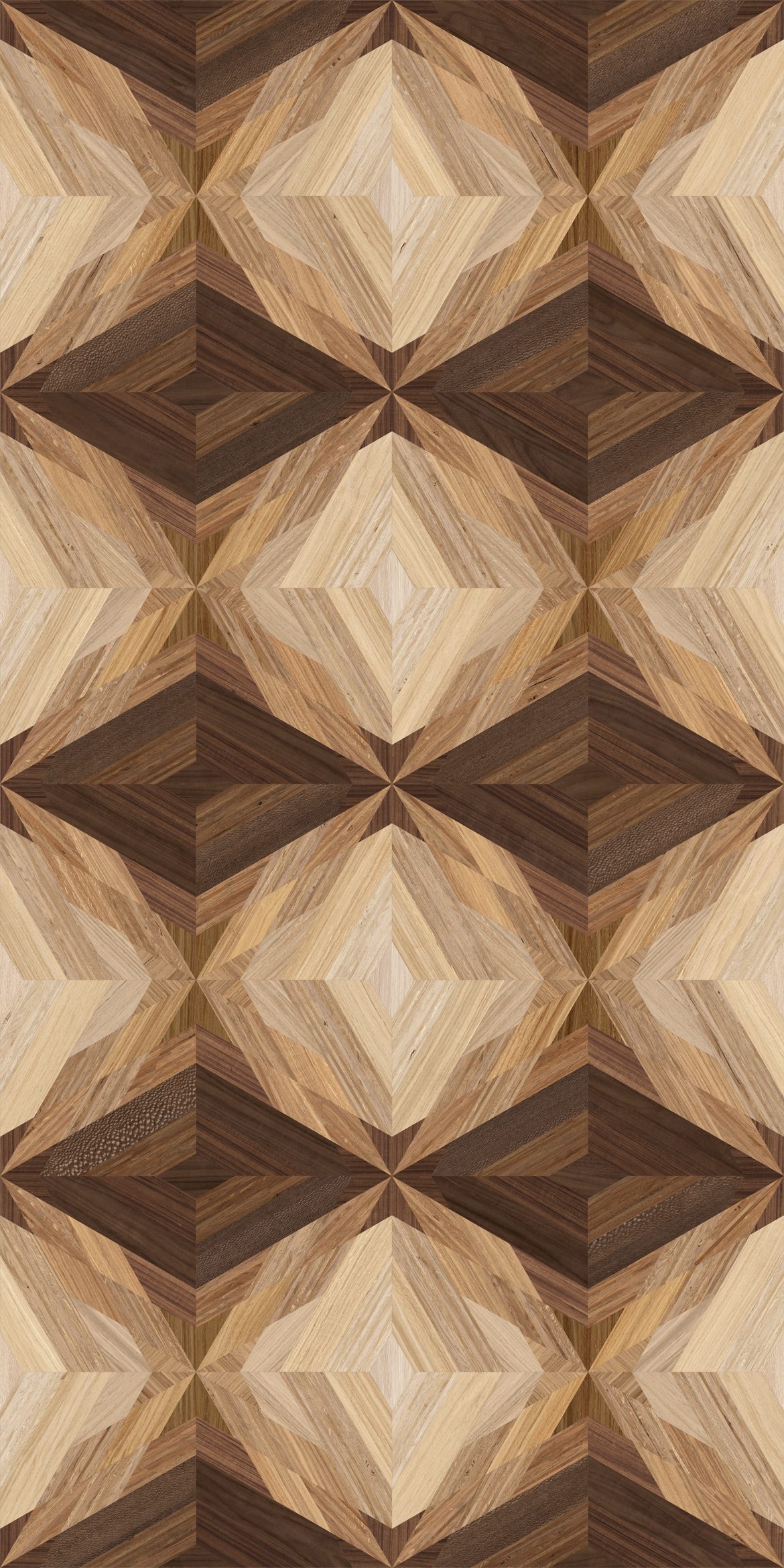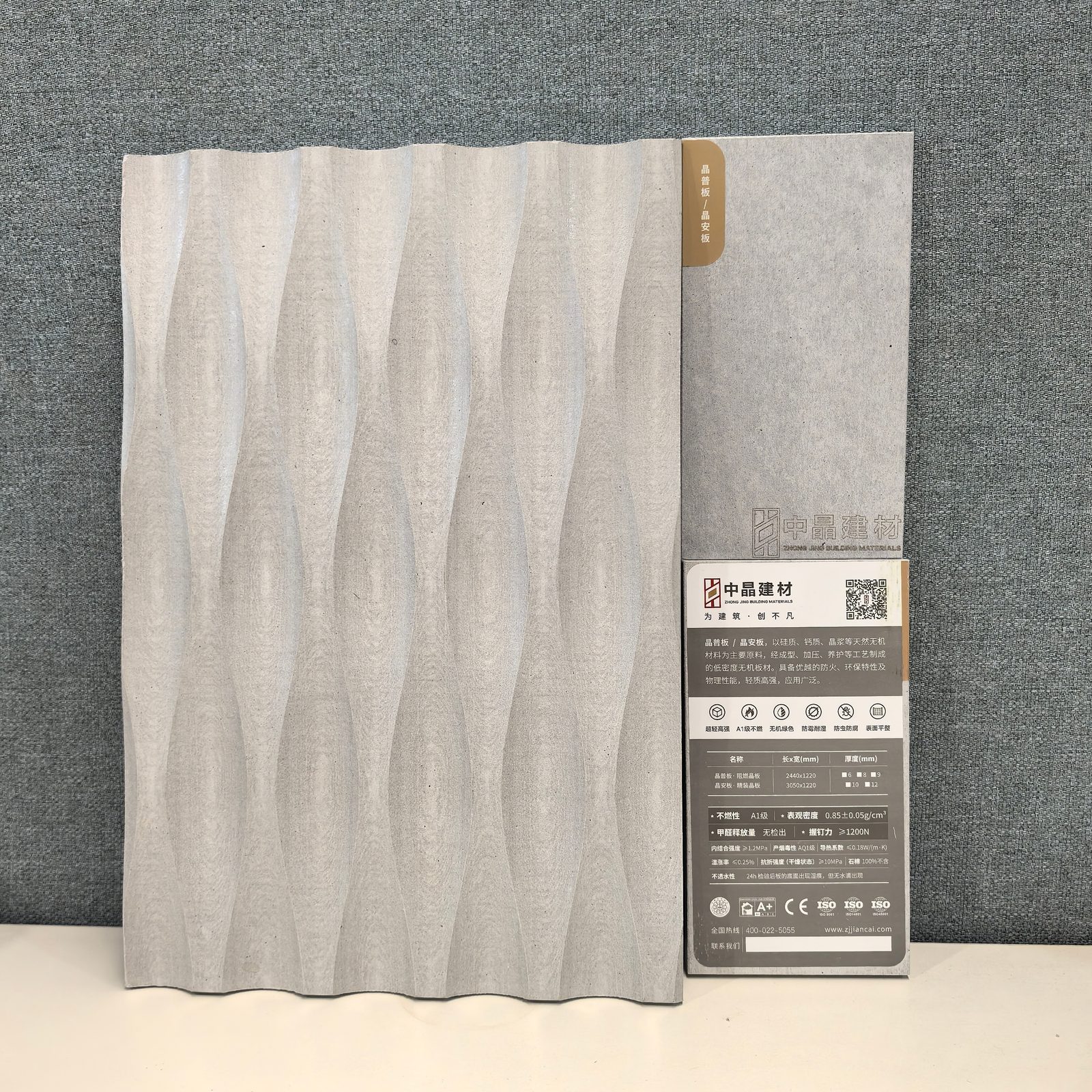
A printed panel can imitate any stone. It cannot imitate a shadow. That is the argument for a carved cement board: the pattern is cut into the surface, so the contrast you see is geometry rather than ink, and it shifts as you walk past the wall. On a 3D wall panel the relief is the design, which means depth, jointing, fixing and lighting have to be specified together — a 2 mm texture and a 6 mm relief are two different products, not two options on the same sheet of fiber cement board.
Why Depth Reads and Print Does Not
A print changes colour; a carving changes angle. Under raking light the crest catches the beam and the trough falls into shadow, that gradient is what the eye registers at distance. As a working rule: 1–2 mm reads as texture within arm's reach, 3–5 mm throws a shadow line at three to five metres, and 6 mm or more holds a sculptural pattern across a double-height space. Two things flatten it — a gloss finish, which turns the surface into a mirror and erases the gradient, and one downlight fixed directly above the panel. Both are specification decisions rather than carving decisions.
How the Relief Is Cut
The core comes first. A carved panel is produced from the same inorganic fiber cement board and calcium silicate board family used for flat work — 0.65–0.85 g/cm³, autoclave cured, flexural strength at least 10 MPa — because a groove cut through a weak board crumbles at the edge. Three routes cover most work: a textured press mould for a shallow repeatable pattern at volume, CNC routing from a digital file for deep or bespoke designs, and hand carving for prototypes. Cutting happens before the finish coat, so the face exposed inside the groove is sealed by the same coating as the crest — the point of a pre-coated coating board rather than site painting.
Depth Classes and What the Board Can Take
| Class | Relief depth | Board | Reads as | Typical use |
|---|---|---|---|---|
| Micro | 1–2 mm | 6–8 mm | Texture, not shadow | Headboards, feature walls, ceilings |
| Standard | 3–5 mm | 8–10 mm | Shadow line at 3–5 m | Reception, retail, restaurant |
| Deep | 6–10 mm | 10–12 mm | Sculptural at 8 m and beyond | Lobbies, screens, facade panels |
The rule that matters is under the groove, not on the face: leave at least 3 mm of material at the base of the deepest cut. Below that the crest chips on site and the section carrying flexural strength is gone. For the deepest patterns a calcium silicate board at the dense end of the range holds a sharper arris than a low-density panel; our thickness guide tabulates 6 mm to 25 mm.
The Module and the Seam
A carved pattern is designed on the panel, not across the wall. Standard modules are 1220 × 2440 mm and 1220 × 3050 mm, so a repeating relief has to divide into those dimensions or the pattern jumps at every joint. The cheapest way to hide a joint is to put it inside a groove: the shadow that hides the carving also hides the seam. A joint landing in a flat field has nowhere to go. Align vertical joints to the axis of the pattern, and carry the pattern around a corner with a return rather than a butt joint.
Fixing Where the Face Is Not Flat
Screws land in a recess, never on a crest: a head sitting proud of the pattern cannot be filled invisibly. Set fixing points on the groove floor or in a designed reveal, and draw the pattern around the stud layout, not the reverse. Screw holding is at least 1200 N, so one fixing in the groove floor carries 15–20 kg — enough at 400 or 600 mm stud centres for ordinary wall panel work. Pre-drill near edges and on deep relief; the sequence is in our installation guide.
Light Is Part of the Specification
Carved samples get approved under a desk lamp, then installed under downlights. Relief needs lateral light: a wall-washer or linear grazer set roughly 300 mm off the face produces the gradient the pattern was drawn for, while one recessed downlight above the panel does the opposite. Specify 3000–3500 K, CRI 90 or better, and keep the source out of sight — on a large decorative board the eye reads the brightest object, not the deepest one.
Fire, Moisture and the Acoustic Trade
Carving is a surface operation on either a fiber cement board or a calcium silicate board core, so the inorganic chemistry is unchanged: A1 non-combustible to GB 8624 with AQ1 smoke toxicity, swelling of 0.25% or less, drying shrinkage of 0.15% or less, and 30 days of immersion with no mould and no delamination. Two effects deserve an honest line. Removing material removes mass, so if the wall is doing acoustic work, put the mass back in the cavity rather than expecting relief to help — see the acoustic performance data. And outdoors, deep relief holds water: 100 freeze-thaw cycles retain at least 80% of flexural strength, but a groove that stays wet is a groove that will spall.
Where Carved Panels Are the Wrong Choice
- Public circulation and impact zones. A groove is where a trolley strike starts a crack — keep deep relief above 1,000 mm.
- Driven-rain facades. Water sits in the trough. Shallow relief on a drained cavity, or stay flat — the facade cladding guide sets out the build-up.
- Dark matt finishes in dusty interiors. Every groove becomes a dust trap that shows on a decorative board.
- Six-week programmes. Carving adds a factory step that flat board does not have.
- Curved work. Carving and bending pull in opposite directions — choose one.
Specifying It Without Regrets
- Give the relief depth in millimetres and the class above, not a photograph.
- State the board and its thickness, and tie the deepest groove to the remaining section.
- Draw the pattern on the 1220 × 2440 module and mark every joint position.
- Mark fixing points on the groove floor and issue the stud layout with the drawing.
- Fix the finish: sheen level, colour reference and whether the cut face is coated.
- Ask for the assembly, not the panel: A1 and AQ1 belong to the board, the hourly rating to the tested build-up — see the fire-rated partition guide.
Frequently Asked Questions
How deep can a carved cement board be cut?
Plan for 1–2 mm on a 6–8 mm board, 3–5 mm on 8–10 mm, and 6–10 mm on 10–12 mm — leaving at least 3 mm of material under the deepest groove.
Is a 3D wall panel printed or actually carved?
Both exist. A print changes colour only and looks identical from every angle; a carving changes angle, so light and shadow move as you pass. Ask for the relief depth in millimetres and a section drawing.
Can carved fiber cement board be used outdoors?
Yes, with restraint: 100 freeze-thaw cycles retain at least 80% flexural strength, but deep relief traps water on a driven-rain facade. Outdoors, use shallow relief on a drained cavity.
How do you hide fixings in a carved panel?
Land every screw on the groove floor or in a designed reveal, never on a crest. At 1200 N holding, one fixing carries 15–20 kg, which covers normal stud centres.
Does carving affect fire or moisture performance?
The chemistry is unchanged through the thickness: A1 with AQ1 smoke toxicity, swelling of 0.25% or less, shrinkage of 0.15% or less. What changes is mass, which matters acoustically, and water retention, which matters outdoors.
Specify carved board when
- The wall has to read from five metres, not only in a hand sample
- Light can be placed laterally — a grazer or wall-washer is available
- The pattern can be drawn on the 1220 × 2440 module
- The face is interior, or exterior with shallow relief on a drained cavity
- Impact at low level can be protected with flat board or a dado
Depth is not decoration. It is the difference between a wall that looks like stone in a photograph and one that looks like stone in the room.
The Bottom Line
A carved cement board earns its cost when the relief is deep enough to throw a shadow, the pattern divides into the panel module, the fixings sit in the grooves, and the light rakes across the face. Get those four right and a 3D wall panel reads at distance instead of disappearing. For the flat-faced options that usually sit beside it on the same job, see the decorative wall panel interiors guide, the stone and wood-look decorative board range and the crystal board overview; certification detail is in our certification guide.