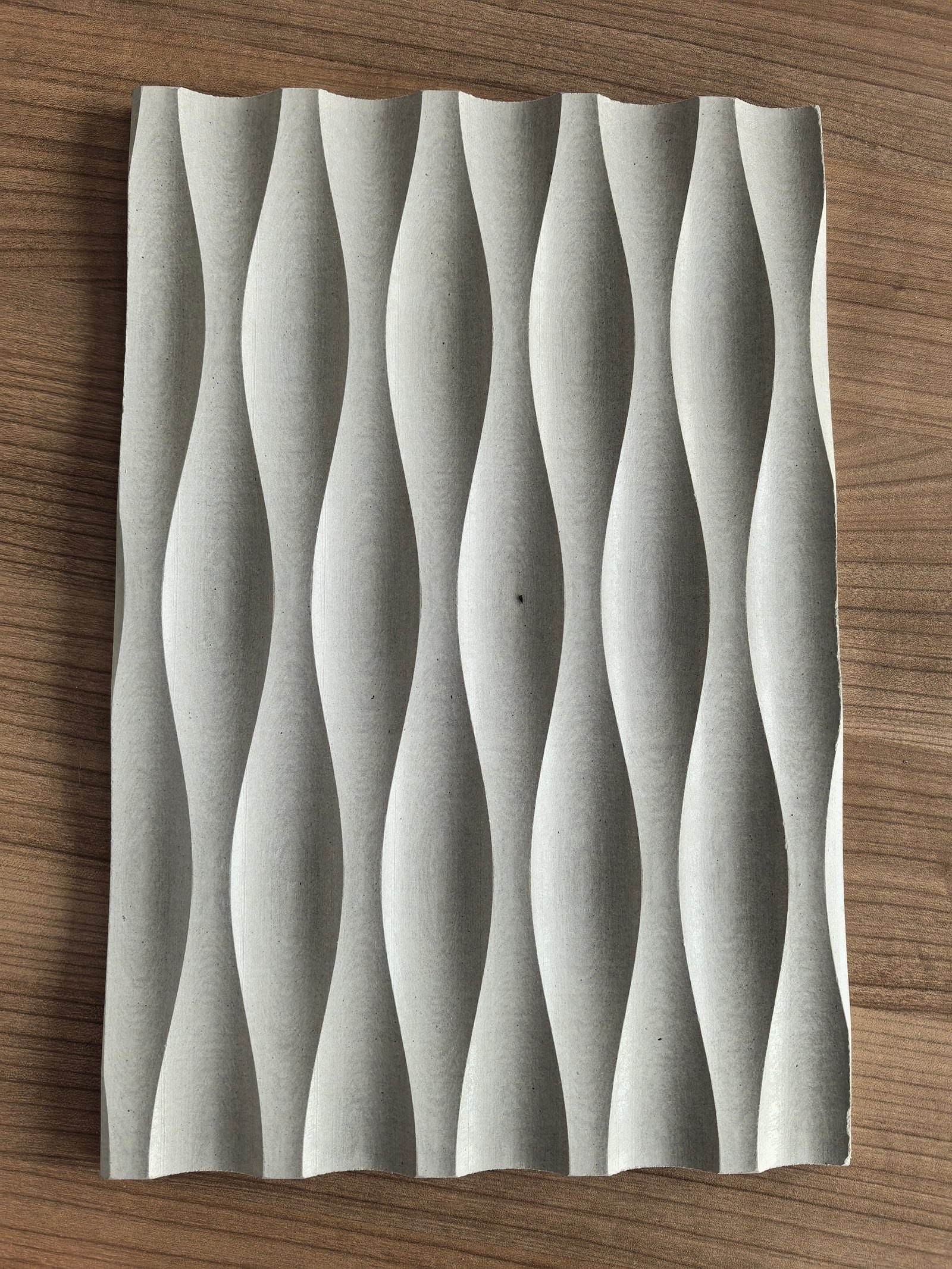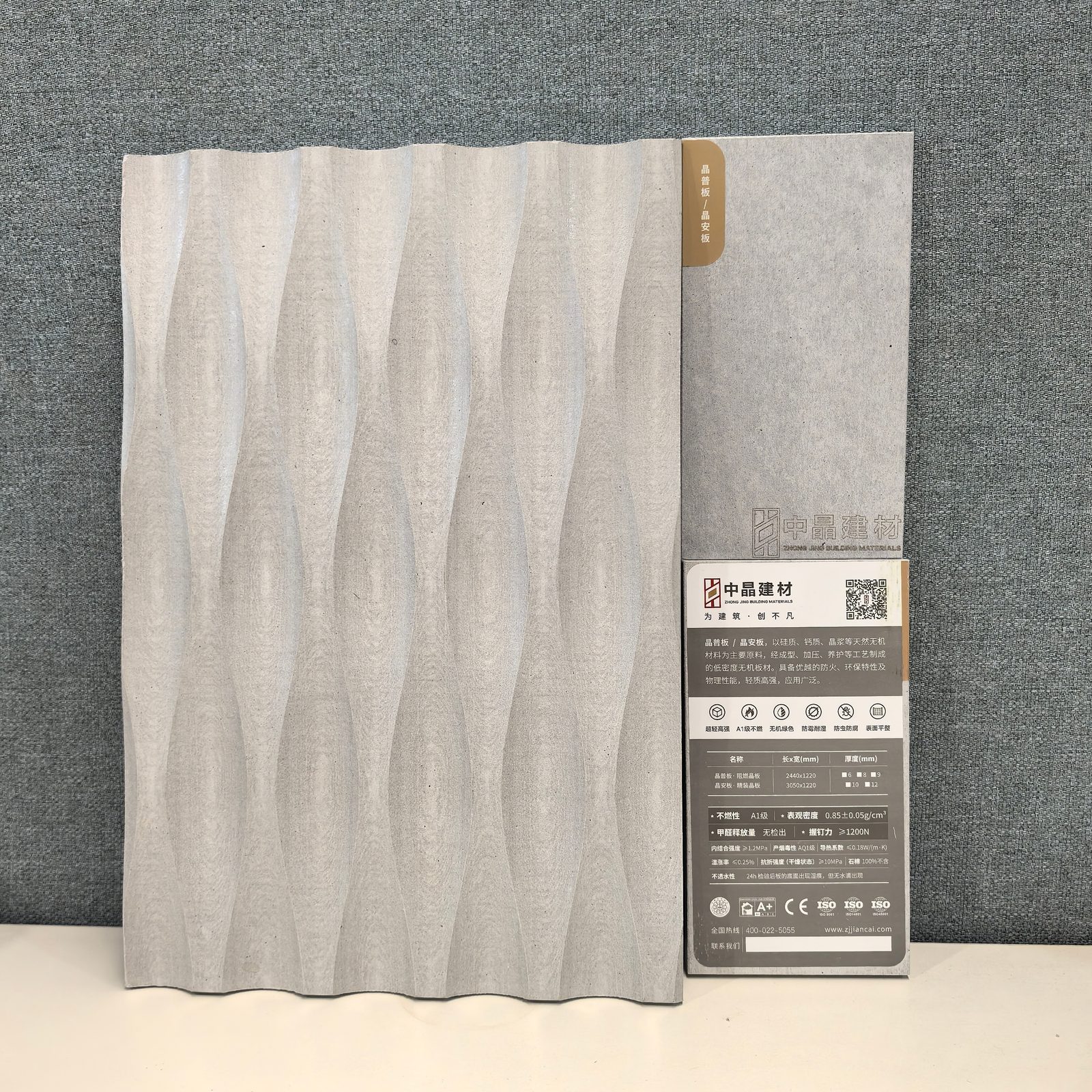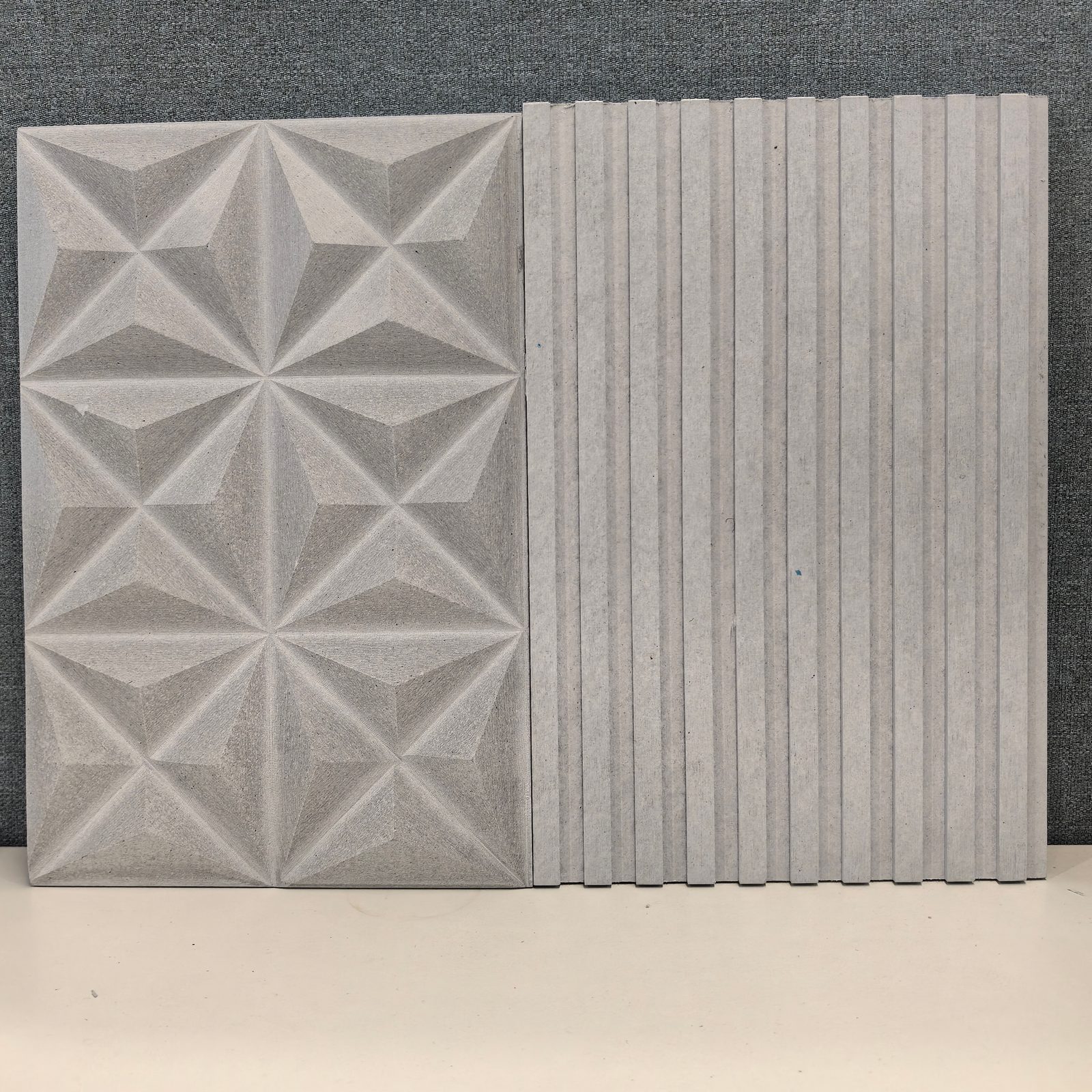
Ask a site manager what slows a fit-out down and the answer is rarely the specification — it is the weight of the material chosen. A sheet needing two people, a hoist and a heavier frame costs time on every panel. Density is where that cost starts, which is why a lightweight fiber cement board wall panel at 0.85 g/cm³ deserves more than a glance at one number in a datasheet.
What 0.85 g/cm³ Actually Means
0.85 g/cm³ is a density, not a thickness and not a strength class. Our low-density range sits between roughly 0.65 and 0.85 g/cm³, against 1.2–1.3 g/cm³ for a conventional fiber cement board and higher still for a dense calcium silicate board. Because weight is density times volume, the difference passes straight to the sheet: one square metre at 0.85 is about 5.1 kg at 6 mm and 10.2 kg at 12 mm, against roughly 7.5 kg and 15 kg for conventional board. That is the “30% lighter” figure, multiplied by every square metre of wall panel or ceiling on the project.
The Weight Ledger, in Kilograms
Specifiers think in millimetres. Think also in kilograms per square metre — the number the structure, fixings and crew actually feel.
| Thickness | At 0.85 g/cm³ | Conventional 1.25 g/cm³ | Difference |
|---|---|---|---|
| 6 mm | 5.1 kg/m² | 7.5 kg/m² | −32% |
| 8 mm | 6.8 kg/m² | 10.0 kg/m² | −32% |
| 9 mm | 7.7 kg/m² | 11.3 kg/m² | −32% |
| 12 mm | 10.2 kg/m² | 15.0 kg/m² | −32% |
| 15 mm | 12.8 kg/m² | 18.8 kg/m² | −32% |
Calculated from nominal density; delivered weight moves slightly with moisture and manufacturing tolerance, so confirm against the declaration of performance. On a full 1220 × 2440 mm sheet — 2.98 m² — a 12 mm panel drops from roughly 45 kg to roughly 30 kg.
Where the Saving Lands
Weight is not abstract; something carries it. On a stud-and-rail partition, board mass drives stud size, fixing density and primary supports; on a ceiling it drives the grid and hangers. On refurbishment it is often decisive: older slabs, timber joists and lightweight roof structures frequently cannot take additional dead load, so a wall panel at 5 kg/m² instead of 7.5 kg/m² is what lets a drylining package proceed without structural strengthening. The same logic governs modular units, where every kilogram of wall travels in the transport frame — see our prefab and modular construction guide.
Strength Without the Mass
Lightness is only worth having if the board survives handling and service. Density here comes from a lightweight crystal slurry binder with mineral and plant fibre reinforcement, formed, pressed and autoclave cured — not from taking material out and hoping. Flexural strength is at least 10 MPa; screw holding at least 1200 N, enough for one fixing to carry 15–20 kg without backing. Fire performance is A1 non-combustible to GB 8624 with AQ1 smoke toxicity: 1000 °C without burning, melting or dripping. And the hourly rating comes from the assembly, not the mass — 8 mm on 75 mm steel studs with rock wool gives one hour, 9 mm two, 12 mm three, as set out in our fire-rated partition systems guide.
Handling, Cutting and the One-Person Sheet
At 6 mm and 8 mm a full sheet is a one-person carry and a one-person position, so a small crew can sequence a room without a second pair of hands or a hoist — wall panel installation stops being a two-trade operation. Cuts are equally forgiving: 6 mm scores and snaps with a utility knife, thicker panels take a saw, as covered in our cutting and tooling guide. Fewer hands on a board also means fewer dropped corners and cracked edges — damage that resurfaces as a snagging list.
Freight, Containers and Site Storage
Export buyers meet density twice: in the wall, and in the container. Board is low-value, high-volume cargo, so kilograms per cubic metre decide how much payload you can use before the weight limit binds. At 0.85 g/cm³ the same container carries more square metres of panel than conventional board, which changes freight per square metre rather than the price of the board. Sea freight also argues for a panel that ignores humidity: swelling 0.25% or less, drying shrinkage 0.15% or less, and 30-day immersion with no mould and no delamination.
Where Ultra-Light Is the Wrong Choice
A light board is not a universal answer, and a supplier who says it is is selling rather than specifying.
- High acoustic separation. Sound insulation follows mass. A 12 mm single-layer partition reaches around 50 dB; beyond that, add mass — a second layer or cavity insulation — rather than expecting a thinner light board to deliver it.
- Direct-fixed exteriors under high wind load. Rigidity and pull-through resistance matter more than handling weight; a denser calcium silicate board or a thicker panel is the honest specification, as our facade cladding guide sets out.
- Floors and heavy impact zones. Work at the upper end of the density band and accept less of the handling benefit.
- Permanently wet service. Indoor wet and dry areas are fine; permanent immersion is not what a low-density panel is for.
The point of offering a density range rather than one board is that a project can move along it: same inorganic chemistry, same A1 reaction to fire, different mass. Where the visible face is the product — a printed or coated decorative board, or a stone-look decorative board for a facade — that flatness is what keeps the finish true.
Specifying It Without Regrets
- State the density, not just the thickness: it sets weight and handling.
- Tie thickness to the fire assembly you need, and ask for the tested build-up rather than a board-only claim. Our thickness guide tabulates weight against rating.
- Give the contractor the load in kg/m² so fixings and substrate capacity are checked against real numbers, whether the finish is a plain wall panel or a decorative board.
- Confirm the certification set: CE with a declaration of performance, French A+, ENF-grade formaldehyde (not detected) and A1/AQ1 fire class — detail in our certification guide.
Frequently Asked Questions
Is a lightweight fiber cement board as strong as a standard one?
Flexural strength is at least 10 MPa and screw holding at least 1200 N. Where more impact resistance is needed, move up the density band or in thickness rather than assuming lighter is better.
What does 0.85 g/cm³ weigh per square metre?
About 5.1 kg at 6 mm, 6.8 kg at 8 mm, 7.7 kg at 9 mm and 10.2 kg at 12 mm — roughly 30% below a conventional 1.2–1.3 g/cm³ board of the same thickness.
Can it be used in wet areas or outdoors?
Indoor wet and dry areas, yes: 30-day immersion produces no mould or delamination. For permanent immersion, direct-fixed facades or high wind load, specify a higher-density board or a calcium silicate board instead.
Does lighter mean weaker fire performance?
No. The board is A1 with AQ1 smoke toxicity, and the hourly rating comes from the tested assembly — 8 mm one hour, 9 mm two, 12 mm three.
Can one person install it?
At 6 mm and 8 mm, yes — carry, position and fix single-handed. At 12 mm and above, plan for two people.
Pick the ultra-light edge when
- Ceilings and partitions where dead load is tight
- Refurbishment on structures that cannot take added weight
- Modular units with transport weight limits
- Small crews fitting out rooms without mechanical lifting
- Export orders where container payload, not volume, is the constraint
Lightness is not a marketing adjective. It is kilograms per square metre multiplied by building area — it lands on the structure either way.
The Bottom Line
At 0.85 g/cm³ a lightweight fiber cement board removes roughly a third of the weight from a wall panel or ceiling build-up without giving up A1 fire performance, 10 MPa flexural strength or a 1200 N fixing. That is a genuine engineering trade, not a compromise — provided it is specified where mass is a cost and not where mass is doing work. For the product family behind these numbers see the Crystal Board overview; our cement board, drywall and plywood showdown puts the weight difference beside the fire and moisture data.