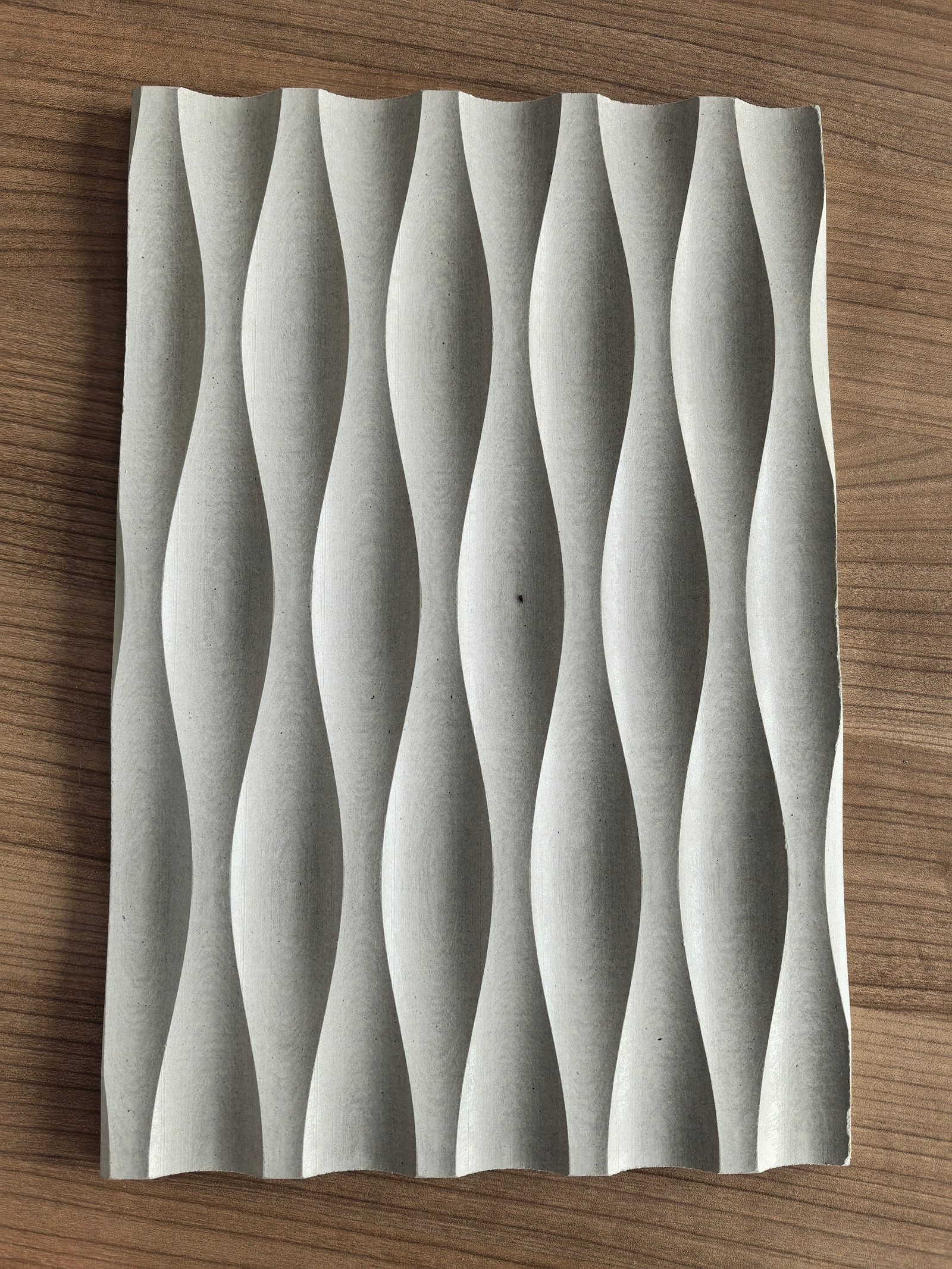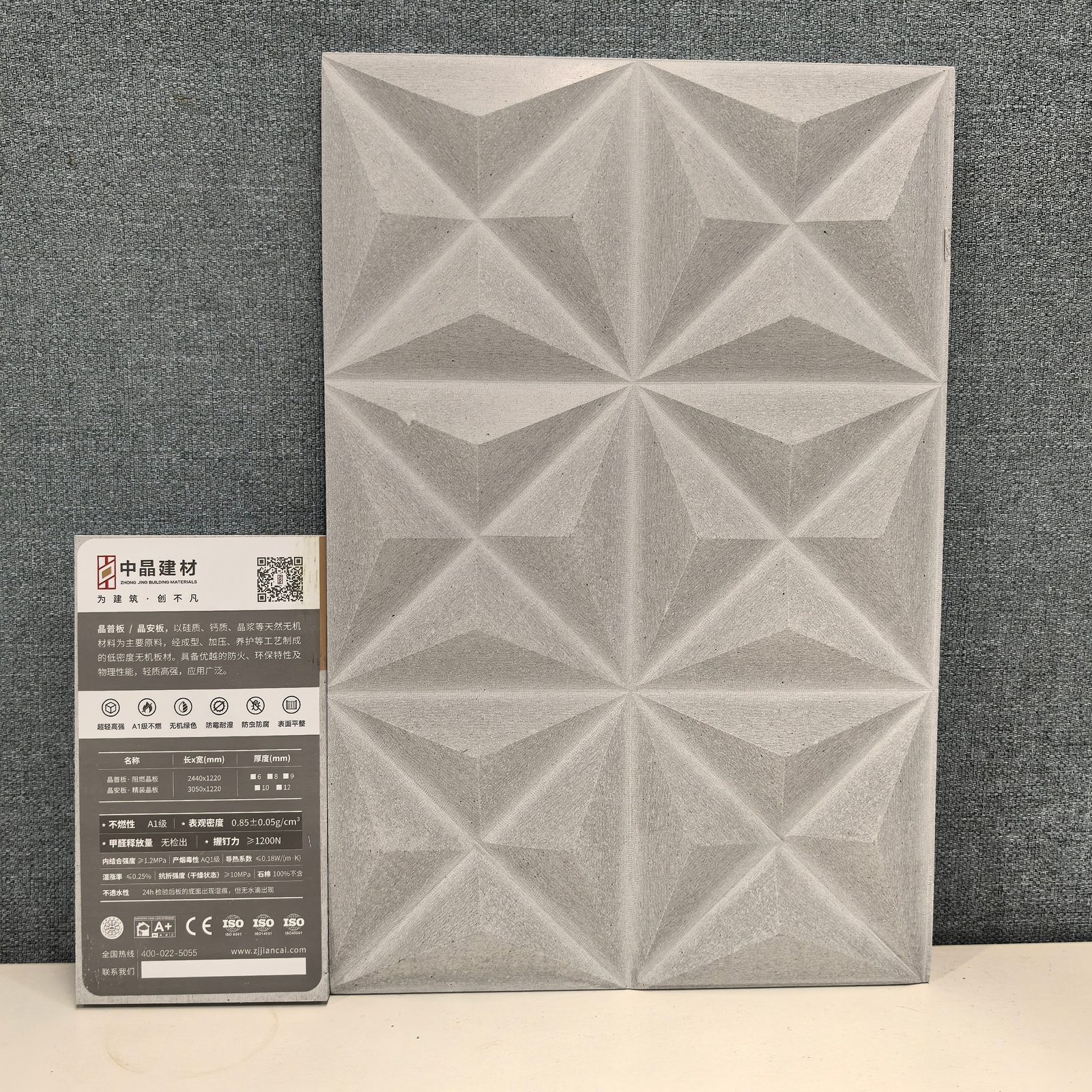
Thickness is the single most consequential decision in a fiber cement board specification. Go too thin and the wall panel flexes, fixings pull out, or the fire rating fails. Go too thick and you pay for weight, material and handling you never needed. This guide maps each thickness in the 6–25mm range to the applications it is actually engineered for — using the same data that appears on our test reports, not marketing claims.
Thickness Range at a Glance
Our calcium silicate board and fiber cement board lines are produced in 4–25mm, with 1220×2440mm and 1220×3050mm as standard formats. With densities spanning roughly 0.65–0.85 g/cm³, weight scales at roughly 0.65–0.85 kg per m² per mm of thickness — a 6mm sheet carries around 4–5 kg/m², a 12mm sheet around 8–10 kg/m². That lightness is what makes a single crew install a full wall panel system without mechanical lifting.
| Thickness | Typical Applications | Key Property |
|---|---|---|
| 6mm | Curved details, ceiling linings, lightweight overlays | Bendable; utility-knife cut; ~4–5 kg/m² |
| 8mm | Ceilings, soffits, 1h fire-rated wall systems | A1 non-combustible core; stable at low weight |
| 9mm | Standard partitions, 2h fire-rated systems | Balanced strength-to-weight |
| 12mm | Fire walls, wet areas, high-holding fixings | Screw holding ≥1200 N; ~50 dB (partition system) |
| 15–25mm | Facades, high-impact linings, structural overlays | Maximum stiffness and impact resistance |
6mm: Curves, Ceilings and Lightness
6mm is the specialist of the range. Because the board keeps its strength while remaining flexible, it is the thickness to specify where a wall panel or lining needs to follow a curve — column casings, arched reveals, serpentine feature walls. It cuts with a utility knife, which means dust-controlled, tool-light work on site, and a full 1220×2440mm sheet weighs in the region of 15–18 kg: genuinely one-person material.
- Curved work: 6mm board can be bent to radius without pre-forming — see our installation guide for the framing method.
- Ceilings: low weight reduces hanger and framing loads, an easy win over heavier cementitious sheets.
- Overlay linings: where an old wall needs a flat, A1-rated substrate under a new finish, 6mm adds performance without adding meaningful load.
8mm: The Fire-Rated Ceiling Standard
8mm is where fiber cement board enters certified fire systems. A tested assembly of 8mm board on 75mm light steel studs with rock wool insulation achieves a 1-hour fire rating — the baseline for corridors, escape routes and many commercial fit-outs. As a ceiling board, 8mm spans standard modular grids without sagging, and its A1 non-combustible rating (no burning, melting or dripping at 1000°C) is what allows it to appear in fire-engineered specifications at all.
9–12mm: Partitions, Fire Walls and Wet Areas
This is the workhorse band for interior construction, and the choice between 9mm and 12mm is usually driven by three numbers:
- Fire rating: tested systems reach 2 hours with 9mm board and 3 hours with 12mm board on insulated steel framing. If the partition is doing fire-separation work, start here.
- Acoustics: a 12mm partition system reaches roughly 50 dB — hotel dividing walls, meeting rooms, clinics.
- Fixings: screw holding of ≥1200 N means a single screw in 12mm board carries 15–20 kg. Wall-hung equipment, cabinetry and TV mounts go in without backing plates — a frequent reason specifiers upgrade from gypsum to a 12mm fiber cement board wall panel.
Wet areas stay in this band too. The board's swelling is ≤0.25% (and ≤0.15% drying shrinkage), so a 12mm calcium silicate board lining in a bathroom keeps joints tight where paper-faced gypsum would soften — the full reasoning is in our waterproof and mold-resistance FAQ.
15–25mm: Facades, Impact and Heavy Duty
At 15mm and above, the board stops being a lining and starts being a structural skin. Specify this band for:
- External facades — wind-load stiffness on the external cladding build-up, and 100-cycle freeze–thaw resistance with ≥80% strength retention.
- High-impact interiors — school corridors, sports halls, back-of-house service walls.
- Structural overlays — mezzanine decking and roof substrates where stiffness matters more than weight.
For balcony soffits and terrace build-ups in this band, see our balcony and terrace cladding guide.
Watch the Installation in Practice
Thickness only pays off when the system behind it is built correctly. This walkthrough shows the full Zhongjing fiber cement board installation sequence on steel framing — the same method used in the 9–12mm partition systems above:
How to Choose: Four Questions
- Is the assembly fire-rated? Match thickness to the certified system: 8mm → 1h, 9mm → 2h, 12mm → 3h.
- What is the stud spacing / span? Wider spans need stiffness — step up from 6mm to 8–9mm before you accept visible deflection.
- What gets fixed to it? Anything hung needs the ≥1200 N screw holding of the 12mm class.
- Who carries it? If handling is a constraint — renovation sites, modular factories, tight stairwells — the 0.65–0.85 g/cm³ density range keeps even 12mm sheets manageable, and prefab and modular lines build entire units around that property.
Quick Specification Map
- Curves & light linings → 6mm
- Ceilings & 1h systems → 8mm
- Partitions & 2h systems → 9mm
- Fire walls, wet areas, hung loads → 12mm
- Facades & impact zones → 15–25mm
Frequently Asked Questions
What thickness of fiber cement board should I use for interior walls?
For most interior partitions, 9–12mm. Use 9mm for standard drywall-style framing and 12mm where you need the higher screw holding, ~50 dB system acoustics or a 3-hour fire rating.
Is 6mm fiber cement board strong enough?
For its intended jobs — curved details, ceilings, overlays — yes. It is bendable, cuts with a utility knife and stays one-person portable. Step up to 9mm or 12mm for impact and hung loads.
What board thickness is needed for a fire-rated partition?
Tested systems with rock-wool insulated steel studs reach 1 hour at 8mm, 2 hours at 9mm and 3 hours at 12mm. Always specify the certified assembly, not the sheet in isolation.
How much does fiber cement board weigh per square metre?
At 0.65–0.85 g/cm³, expect roughly 0.65–0.85 kg/m² per millimetre: 6mm ≈ 4–5 kg/m², 12mm ≈ 8–10 kg/m², 25mm ≈ 16–21 kg/m².
The right thickness is the thinnest sheet that still carries the fire rating, the span and the fixings your system demands. Everything above that is weight you are transporting for free.
Conclusion
Across the 6–25mm range, every step in thickness buys a specific capability: bendability at 6mm, certified fire assemblies from 8mm, fixing strength and acoustics at 12mm, and facade-grade stiffness from 15mm up. Specify against those capabilities — not against habit — and a fiber cement board or calcium silicate board system lands lighter, faster and safer. When a project needs a decorative face over the substrate, our decorative board range mounts directly onto the same framing at any of these thicknesses.