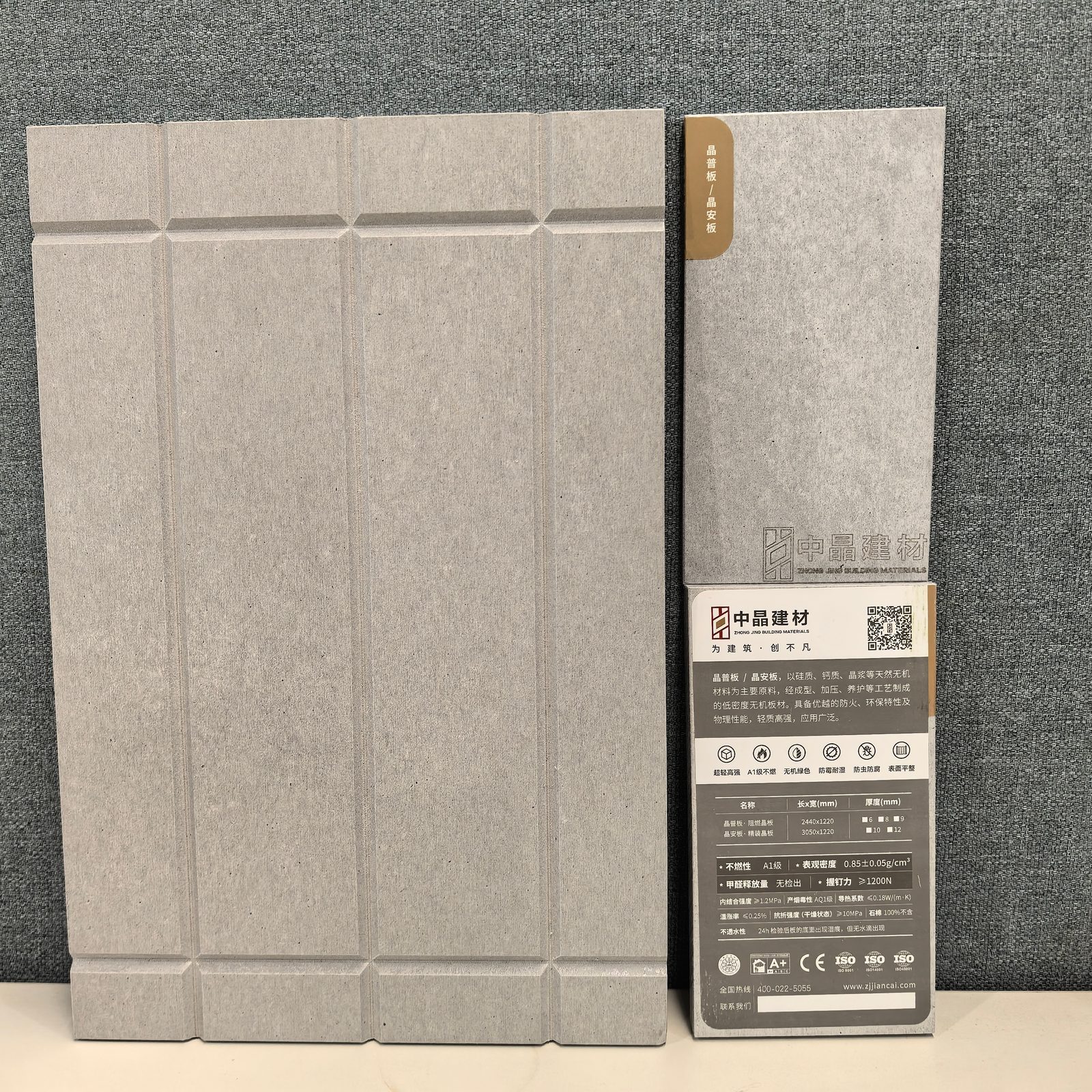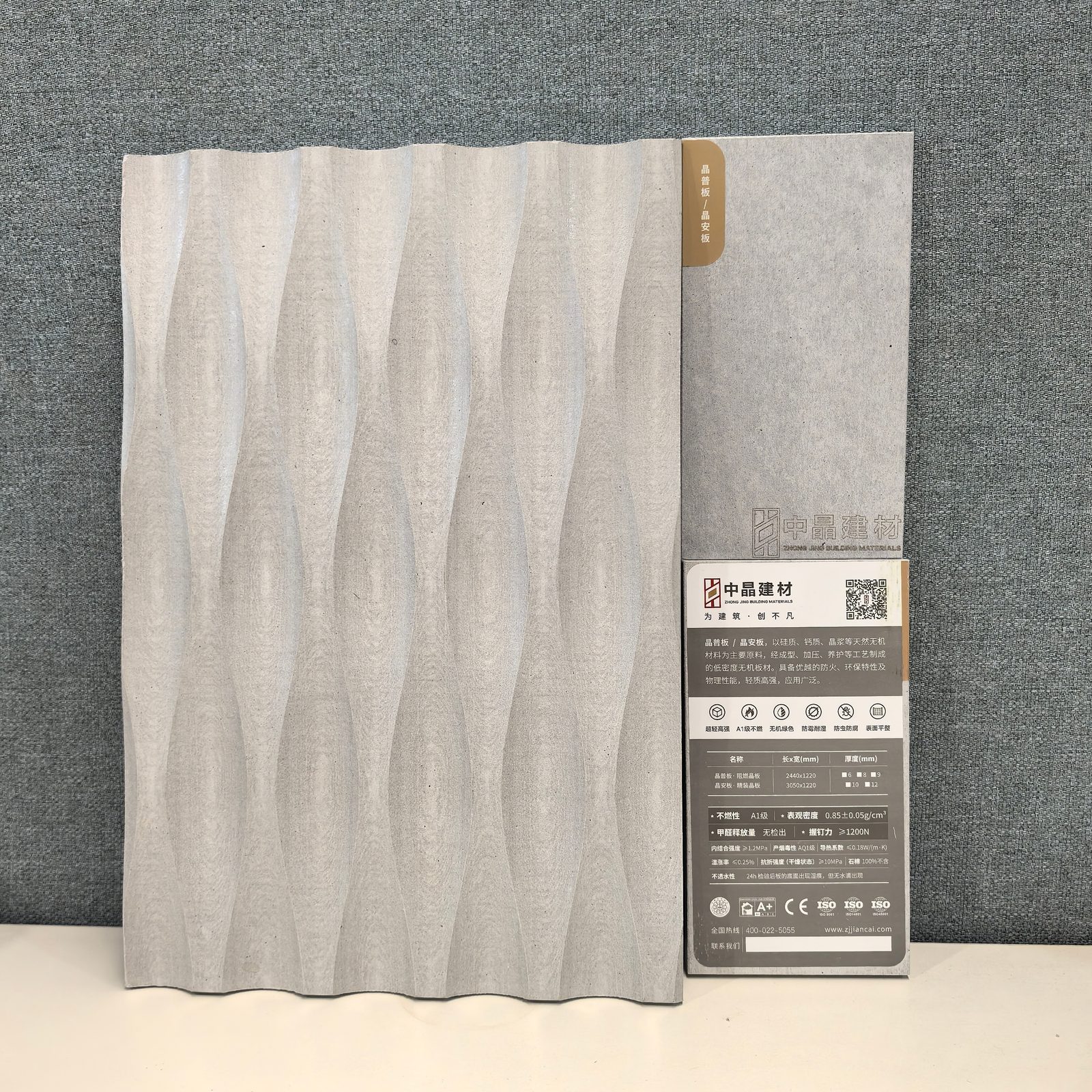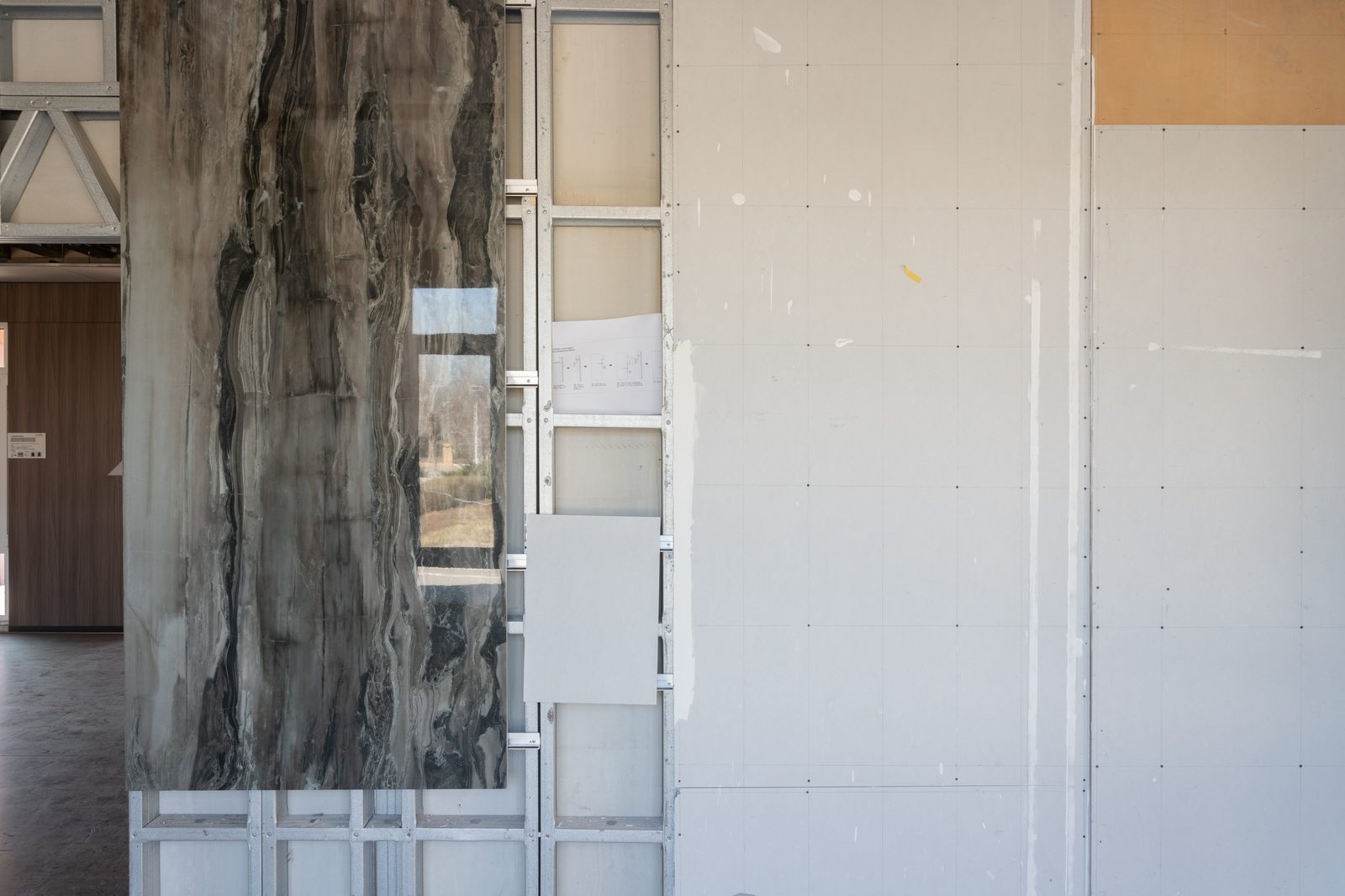
Ceramic tile has been the default answer for hard wall surfaces for decades, and for good reason: it is dense, waterproof at the face, scratch-resistant and available everywhere. But "default" is not the same as "best fit", and on many interior walls the tile system — tile plus adhesive plus grout plus the substrate behind it — is doing a job that a single-board wall panel system could do with less weight, fewer joints and a shorter installation window. This guide compares fiber cement board and ceramic tiles for wall cladding on the factors that actually drive project outcomes: installed weight, cracking behavior, moisture, installation speed, maintenance, lifespan and where the cost really sits.
One framing note before the comparison. Ceramic tile and fiber cement board are not always competitors — tile remains the right call for many floors, splash zones and surfaces that see daily scrubbing with abrasive cleaners. The comparison below is specifically about wall cladding: large vertical areas in lobbies, corridors, hotel rooms, offices, retail fit-outs and wet-side walls, where coverage speed, weight and joint behavior dominate the decision.
The System vs. The Sheet
The first difference is structural in the commercial sense. A ceramic tile wall is a system of four layers: the tile, the adhesive bed, the grout joints, and the substrate (render, screed or a backer board) that carries it all. Each layer is a separate trade, a separate curing time and a separate failure mode. A fiber cement board wall is a single factory-made sheet fixed to a stud frame or adhesive-dot applied to a sound wall, finished at the joints and ready to receive paint, veneer or leave exposed as a finished surface.
That difference cascades through everything below. Weight, installation time, cracking, and total cost per square meter are all consequences of one material being a fired fragment assembled on site and the other an engineered panel manufactured to a flatness and strength spec before it leaves the factory.
Weight: What the Wall Actually Carries
| Factor | Ceramic tile system | Fiber cement board |
|---|---|---|
| Facing weight | Tile 10–25 kg/m² plus adhesive bed, typically 4–8 kg/m² more | 6–12 mm board at 0.65–0.85 g/cm³: roughly 4–10 kg/m² |
| Total on substrate | Often 20–35 kg/m² before substrate | Single sheet, no adhesive bed |
| Structural implication | Heavy cladding on high-rise partitions adds load and seismic mass; refurbishment walls may need checking | Light walls suit retrofit and upper floors; slab load barely changes |
The weight gap is not cosmetic. On high-rise residential work, every kilogram per square meter on partition walls multiplies across thousands of square meters of facade-facing partition, adding to the structural frame and the seismic mass. In refurbishment, a tile-over-tile or tile-on-old-render proposal frequently stalls because the existing wall cannot be verified to carry the new build-up. A lightweight wall panel build-up sidesteps that conversation: low-density fiber cement board runs around 30% lighter than conventional fiber cement products, and a 6 mm sheet weighs about 18 kg — one person, no hoist.
Cracking and Joints: How Each Surface Fails
Ceramic tile is strong in compression but brittle in flexure. When the wall behind it moves — frame deflection, thermal expansion, shrinkage of the render bed — the movement has to go somewhere. It usually goes to the grout joints, which crack and stain, or to the tiles themselves, which crack or debond. This is why tile specifications devote so much space to movement joints, expansion joint profiles, adhesive class and substrate preparation: the system's weak points are known, and the specification is an exercise in managing them.
Fiber cement board approaches the problem from the other side. The board itself is dimensionally stable — wet expansion of 0.25% or less and dry shrinkage of 0.15% or less — so it does not generate the movement that breaks brittle faces. Joints between boards are finished with tape and compound (or left as expressed shadow-gap joints in decorative schemes), and because the finished surface is not brittle, minor building movement shows up as nothing worse than a hairline at a joint that can be touched up. A calcium silicate board substrate behaves the same way, which is why both boards are widely used as the backer layer under tile in wet areas — and equally widely used as the finished wall themselves.
The Specifier's Short Version
- Tile is a 4-layer site-assembled system; fiber cement board is one factory sheet.
- Tile cracks at grout and tile when the wall moves; inorganic board is dimensionally stable and finished flexibly at joints.
- Tile wins where the surface must survive scrubbing and impact point loads; board wins on speed, weight and large uninterrupted planes.
- Neither needs to lose: board is the proven backer under tile in wet areas — and the finished wall where tile is overkill.
Installation: Schedule, Trades and Site Conditions
Installation is where the two materials diverge most sharply in cost structure. A tiled wall sequence runs: substrate preparation, waterproofing where required (and curing time), layout and setting out, adhesive application, tile fixing, grouting, and cleaning — with curing waits between the waterproofing, fixing and grouting stages. On a hotel floor of several hundred square meters of wall, that is a wet trade sequence measured in weeks, with quality dependent on the tiler on the day.
A fiber cement board wall runs: frame or batten installation (or direct adhesive fixing), board fixing with screws, joint treatment, and finishing. The board is cut with a utility knife by scoring and snapping, which removes dust-heavy power cutting from occupied buildings, and the surface arrives flat enough to receive direct decoration with no plaster skim. The video below shows a typical wall panel installation sequence with the board.
For fit-out programs the practical difference is usually expressed in one sentence by contractors: tile walls hold up the next trade; board walls let the next trade start the same week. Fast fit-out is also why prefabricated bathroom and kitchen modules almost universally use cement-based boards rather than site tiling for their wall shells — see our guide on prefab and modular construction with fiber cement board.
Moisture Behavior
Both materials are moisture-tolerant at the face, but they differ behind it. Ceramic tile itself does not absorb much water — but the grout joints do, and the adhesive bed and substrate behind a tiled wall can hold moisture for long periods. Failures in tiled showers and wet walls are overwhelmingly substrate failures: water migrates through grout, saturates the render or plasterboard behind, and the tile debonds or the substrate swells and cracks the face. The same movement sensitivity limits decorative schemes: a tiled feature wall is locked into its grout grid, whereas a decorative board finished in wood grain, marble effect or a custom printed pattern presents large uninterrupted planes without a single grout line.
Fiber cement board and calcium silicate board are inorganic through their full thickness. Wet expansion of 0.25% or less, dry shrinkage of 0.15% or less, and no paper facing or organic fraction to feed mold — the material is effectively sterile to fungal growth. This is why the same board family covers both sides of the wet-area decision: as the backer beneath tile in showers (see our bathroom wall panel waterproofing guide), and as the finished board surface in plant rooms, basements and laundry walls where tile is unnecessary. For kitchen applications the same logic applies to splash zones — see the kitchen backsplash panel guide.
Maintenance and Repair
| Scenario | Ceramic tile wall | Fiber cement board wall |
|---|---|---|
| Surface soiling | Easy to wipe; grout lines discolor and need periodic treatment | Painted or coated surface wipes down; no grout lines |
| Cracked unit | Matching replacement tiles often unavailable years later; removal risks neighbors | Joint or panel patch, repaint the section; no unit-matching problem |
| Behind-the-wall access | Demolition of the field to open the wall | Board section removed and refixed |
| Refurbishment cycle | Strip-out produces heavy rubble; adhesion of new layers to old tile is a known risk | Over-cladding on battens is a standard, lightweight refurbishment route |
On lifespan, both are long-lived when installed correctly. Fired ceramic is essentially permanent as a material; its service life is usually limited by the system around it — grout, adhesive and substrate. Cement-based board similarly lasts the life of the building when kept within its design envelope; its weak points are joint workmanship and mechanical damage at corners, both repairable locally. The realistic comparison is therefore not "which lasts longer" in a laboratory, but "which system reaches 20 years with fewer visible defects and cheaper interventions" — and on large wall areas, the single-sheet system with flexible joints generally ages more gracefully than a field of brittle units on a rigid bed.
Where the Cost Actually Sits
We do not publish prices, and material unit prices alone would mislead anyway — the tile system's material cost is diluted across tile, adhesive, grout, profiles and substrate preparation, while its labor and time costs dominate. The honest comparison is structural:
- Labor intensity. Tile fixing is skilled piecework on the critical path; board fixing is general carpentry-level work at a much higher square-meter-per-day rate.
- Program cost. Curing waits in the tile sequence extend the fit-out program; on hotel and retail work, program time is usually worth more than the material delta.
- Substrate cost. Tile needs a prepared, dimensionally adequate substrate; a fiber cement board wall panel is the substrate and the finish in one.
- Refurbishment cost. Tile strip-out is expensive and heavy; board over-cladding is light and fast.
Where tile genuinely wins on cost logic is small, high-abuse areas — a few square meters behind a commercial kitchen line or on a washdown wall — where its per-area setup cost is amortized by toughness. As the wall area grows and the surface stays vertical and dry-to-moist, the board system's advantage compounds.
Design Flexibility and Finish Options
Ceramic tile offers a vast library of colors and formats, and for feature walls demanding a glazed, high-gloss ceramic look it remains a legitimate choice. Fiber cement board answers with a different kind of flexibility: the board is a flat, paint-ready canvas that accepts any architectural coating, and within the same product family it extends into factory-finished surfaces — UV-coated decorative board ranges with wood grain, marble effect and solid color finishes, and digital-print decorative board lines that reproduce custom patterns panel by panel. Because those finishes are factory-applied on a dimensionally stable inorganic core, large-format wall panel elevations stay joint-consistent and flat in a way that a large tiled field, with its many grout lines, does not. For interiors that want the stone or wood look without tile's joint pattern, the material comparison guides and our product pages cover the decorative ranges in detail.
The Combined Answer: Board Under Tile, Board Instead of Tile
The most useful conclusion for a specifier is that this is not a fight to the finish. In wet areas, low-density fiber cement board and calcium silicate board are the established backer layer under ceramic tile precisely because they are stable, inorganic and mold-sterile — they fix tile's biggest weakness (substrate failure) without touching its strengths. And on the large vertical fields where tile is specified by habit rather than necessity — corridor walls, hotel room walls, office lobbies, ceiling-height feature walls — the same board becomes the finished wall panel system: lighter, faster, fewer joints, and easier to refurbish. Specifying both, each where it is strongest, is the configuration that performs best per unit of budget and program time.
FAQ: Fiber Cement Board vs Ceramic Tiles
Is fiber cement board cheaper than ceramic tiles for wall cladding?
Material unit prices vary by market, so the reliable comparison is installed cost: a fiber cement board wall panel replaces the substrate, adhesive and tile layers with a single fixed sheet, cutting skilled-labor hours and eliminating curing waits from the program. On large vertical areas the board system typically lands lower in total installed cost, while tile remains cost-effective for small, high-abuse areas where its toughness justifies the system build-up.
Which lasts longer, ceramic tile or fiber cement board?
As raw materials both are effectively permanent, so the question is really about the system. Tile service life is usually limited by its grout, adhesive and substrate — the parts that crack or hold moisture. Fiber cement board is dimensionally stable (wet expansion ≤0.25%, dry shrinkage ≤0.15%), inorganic and mold-resistant through its full thickness, with flexible joint finishing that tolerates building movement. On large wall areas the single-sheet system generally reaches 20 years with fewer visible defects and cheaper repairs.
Can fiber cement board be used behind tiles in showers?
Yes — and it is one of its strongest applications. Fiber cement board and calcium silicate board are standard backer layers under ceramic tile in wet areas: inorganic through the core, no paper facing to swell, wet expansion of 0.25% or less, and no nutrient for mold. The substrate failure that commonly debonds tiled showers is largely eliminated when the tile is applied over a cement-based backer board instead of render or gypsum plasterboard.
What are the main disadvantages of ceramic tile walls compared with board systems?
The trade-offs are structural, not material: tile walls are heavy (commonly 20–35 kg/m² including the adhesive bed), the field depends on grout joints that discolor and crack under building movement, installation is a multi-stage wet trade with curing waits, and later repairs face tile-matching problems. Fiber cement board addresses those points with one lightweight factory sheet and paint-ready or factory-finished decorative surfaces — though for surfaces that must survive daily abrasive scrubbing, glazed tile still holds an edge.