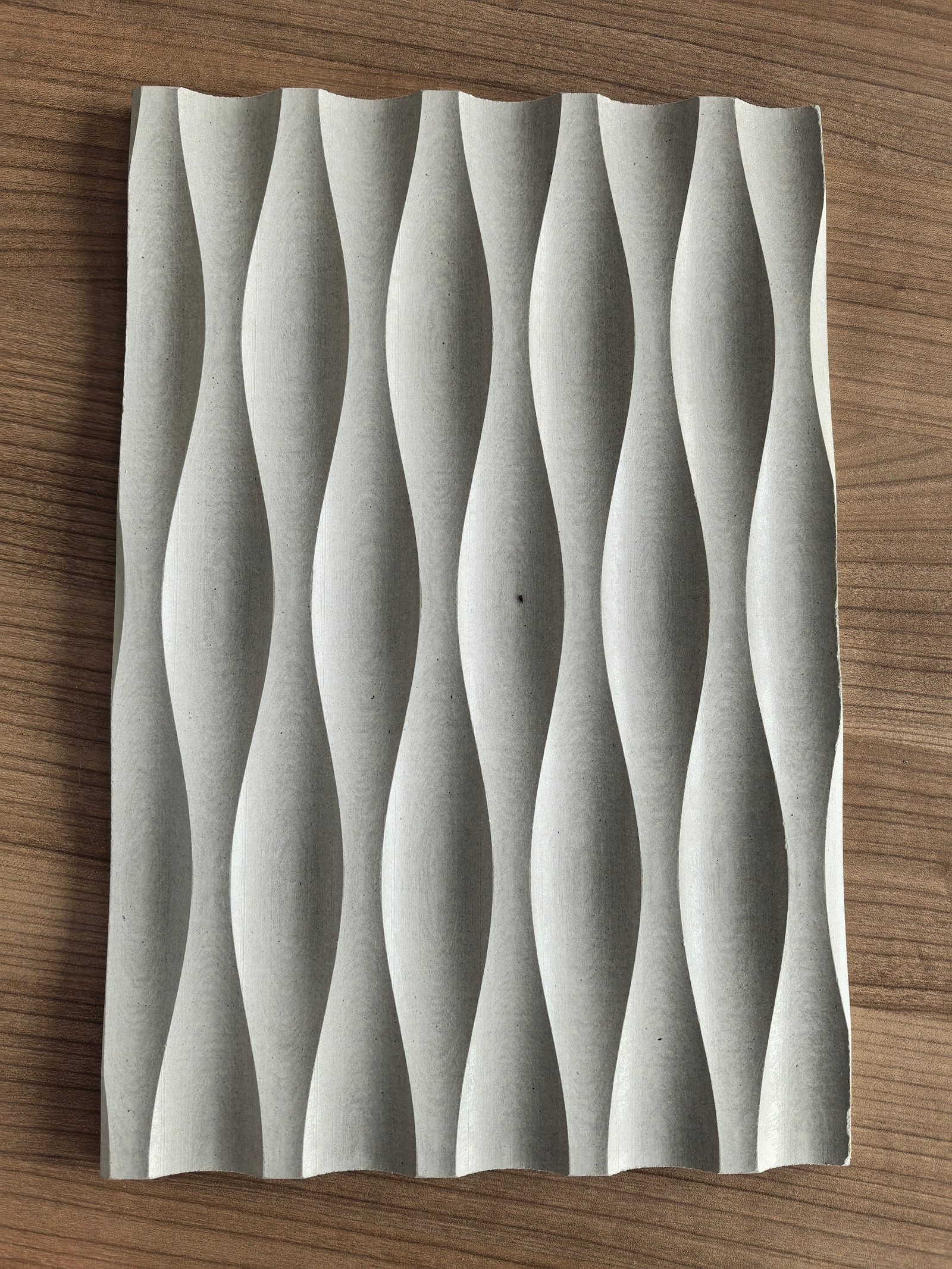
Every interior fit-out faces the same early decision: what goes underneath the finish? For years the default answer was a wood-based board — OSB or plywood — for structure, and gypsum board for walls and ceilings. Crystal Board enters that conversation not as a niche alternative, but as a material that beats each on the properties specifiers care about most.
The Contenders at a Glance
| Property | Crystal Board | OSB / Plywood | Gypsum Board |
|---|---|---|---|
| Fire reaction | A1 non-combustible | B1 (treated) / flammable; toxic smoke | B1 (paper-faced); paper burns |
| Moisture behavior | <0.2% absorption, mold-proof | Swells, warps, rots | Softens, crumbles, sags |
| Formaldehyde | ENF (not detected) | Present (resin-bound) | Low, but glue & paper |
| Density (typical) | 0.85 g/cm³ (flagship) | 0.6–0.7 g/cm³ | ~0.7–0.9 g/cm³ |
| Screw holding | ≥1200 N | Moderate, weakens when wet | Weak; needs double layers |
| On-site prep | No putty, ready finish | Sanding, sealing | Skim coat + sanding |
| Wet-area use | Yes | Limited / treated only | No |
Against OSB & Plywood (Oriented Strand Board)
Wood-based boards earn their place through familiarity and low upfront price. But their weaknesses are structural, not cosmetic:
- Fire is the deal-breaker. Even "fire-retardant" plywood is essentially wood with additives — it still carbonizes and releases toxic smoke (smoke toxicity typically ZQ1, "conditionally safe"). Crystal Board is A1: 1000°C without burning, melting, or dripping, with AQ1 safe smoke.
- Moisture is the silent killer. OSB and plywood absorb water, swell, and delaminate — especially in basements, bathrooms, and coastal sites. Crystal Board shrugs off 30-day immersion.
- Formaldehyde lingers. Resin-bound wood boards off-gas for years. Our boards are fully inorganic with ENF-grade (not detected) emissions.
- Resource & carbon. Inorganic boards consume no timber and carry a fraction of the embedded carbon of processed wood composites.
The only place wood still "wins" is raw material cost — and even that gap narrows once you price in rework, mold remediation, and fire-safety upgrades.
Against Gypsum Board
Gypsum board dominates drywall for good reason: it is cheap and easy to finish. But it is fundamentally a moisture- and impact-sensitive product:
- Paper faces burn. The gypsum core is non-combustible, but the facing paper ignites and the board loses integrity in fire. Crystal Board is A1 through and through.
- Water is its enemy. A leak or high humidity softens gypsum, causes sagging and powdering. Crystal Board's 0.2% absorption means it simply does not care.
- Two-step finishing. Gypsum needs joint compound, skim coat, and sanding. Crystal Board's flat surface takes finish directly — collapsing a trade and a schedule.
- Load-bearing weakness. Hanging anything heavy on gypsum requires backing or double layers; a single Crystal Board screw holds 15–20 kg.
Total Installed Cost, Not Just Sticker Price
A material's true cost is what it takes to get it into a finished wall that performs for decades:
- Labor: fewer steps (no putty/skim/sand) and lighter sheets cut handling time.
- Rework: mold, swell, and fire-upgrade callbacks disappear.
- Lifecycle: inorganic boards do not rot, off-gas, or degrade in humidity — lower maintenance and replacement risk.
- Compliance: A1 + CE + French A+ de-risks approvals in fire- and air-quality-regulated markets.
When to Choose Crystal Board
- Fire-rated walls, ceilings, and escape routes
- Any wet or humid space (basement, bath, balcony, kitchen)
- Healthcare, school, and residential projects with air-quality limits
- Prefab / modular builds needing light, stable, dry-installed substrate
- Projects targeting green-building certifications
Wood and gypsum solved a 20th-century problem. Crystal Board solves the 21st-century one: build fast, build safe, build clean — without trading one risk for another.
Conclusion
OSB, plywood, and gypsum each have a role, but for the substrates that define a building's safety, durability, and indoor air quality, Crystal Board is the rational upgrade. It is not "greener at a penalty" — it is better on the metrics that matter and simpler to install.