A wet-room wall almost never fails because somebody emptied a bucket over it. It fails because a small amount of moisture arrived, repeatedly, somewhere the assembly could not dry — behind a tiled face, under a bath rim, inside a service void. Months later the finish blisters, a grout line opens, and the board gets the blame, when it was the last link in a chain that had already failed further back.
Buyers compare boards as though the board were the system. It is not. What separates a wall that survives fifteen years of showers from one that smells of damp in year three is an inorganic substrate, a drying path and sealed edges — in that order, and only the first is on a datasheet.
Four Ways Water Reaches a Wall
- Bulk water. A failed seal or a flood from above — fast, visible, usually fixed.
- Capillary rise. Ground moisture climbing out of a slab — why a basement lining dry in September is black in July.
- Vapour diffusion. Humid air crossing a lining towards a drier, cooler space, a little every day.
- Interstitial condensation. Vapour condensing at the dew point inside the cavity, where nobody sees it.
The last two are the expensive ones: no puddle, no complaint, until the damage is done. They explain why a humidity-rated panel still fails when the assembly traps moisture against its back face.
What Moisture Does to Wood-Based Panels
Wood-based substrates are hygroscopic by design — which is what makes them cheap and familiar, and what makes the damage permanent. Water enters the cell walls and glue lines, the panel swells, and it does not return to its original thickness when it dries.
| Substrate | When it gets wet | What is left afterwards |
|---|---|---|
| OSB | Edges swell unevenly as strands take up water | Permanent edge swell, a ridge under the finish, a joint that will not close |
| MDF / HDF | Dense fibre wicks water; the panel softens through its thickness | Lost screw grip and lower stiffness, even after drying |
| Plywood | Water finds veneer edges and glue-line voids | Delamination that cannot be repaired |
| Paper-faced gypsum | The paper face absorbs water and the core crumbles | A face that peels away, taking the finish with it |
The damage is cumulative, so a slow leak is often worse than one flood dried out at once. And it stays hidden until it reaches the finish: fixings lose grip, the lining shifts, the joint opens, water gets a direct route, and the next cycle starts wetter. That is how tiles end up on the floor of a three-year-old bathroom.
The Mould Equation Has One Variable You Can Specify
Mould needs spores, food, moisture and a suitable temperature, held long enough to colonise. Spores are everywhere and the temperature window belongs to the occupants, so only the food term is yours to specify. Cellulose is food — and so is the starch sizing in paper, the dust behind a service void and the adhesive residue on a new board.
A wood-based panel is therefore not merely a material that gets wet: it feeds the infestation and holds the moisture it needs. Surface treatments slow colonisation but do not change what the panel is made of. A fiber cement board removes the food term — not the moisture or spore terms, which is why cleaning still matters — and there is no mycelium through its thickness because there is nothing in it to digest.
What an Inorganic Panel Does Differently
A fiber cement board or calcium silicate board is inorganic through its full thickness: silica and calcium bound in a cementitious matrix, reinforced with mineral and plant fibre, pressed and autoclave-cured. Nothing in it swells like a cell wall, so the dimensional response to humidity is an order of magnitude smaller than a wood-based panel's.
- Wet expansion 0.25% or less, dry shrinkage 0.15% or less. On a 2,400 mm board, movement in single millimetres — small enough for a detailed joint to absorb.
- No delamination or mould after 30 days of immersion. Not a pool liner, but it survives a site that gets wet before it is closed.
- Density 0.65–0.85 g/cm³. About 30% lighter than a standard fiber cement board — it matters when a crew lifts a wall panel overhead all day.
- Flexural strength ≥10 MPa, screw-holding ≥1,200 N. One fixing holds 15–20 kg, and that grip does not soften when the wall gets damp.
- A1 non-combustible, AQ1 smoke toxicity, formaldehyde not detected (ENF), CE, French A+ and REACH. Wet areas sit beside kitchens and stair cores.
The value is not the word “waterproof”, which no board should claim alone, but dimensional stability: the finish stays bonded, the joints stay closed and nobody has to demolish the wall to find out what went wrong.
A Panel Is an Assembly, Not a Board
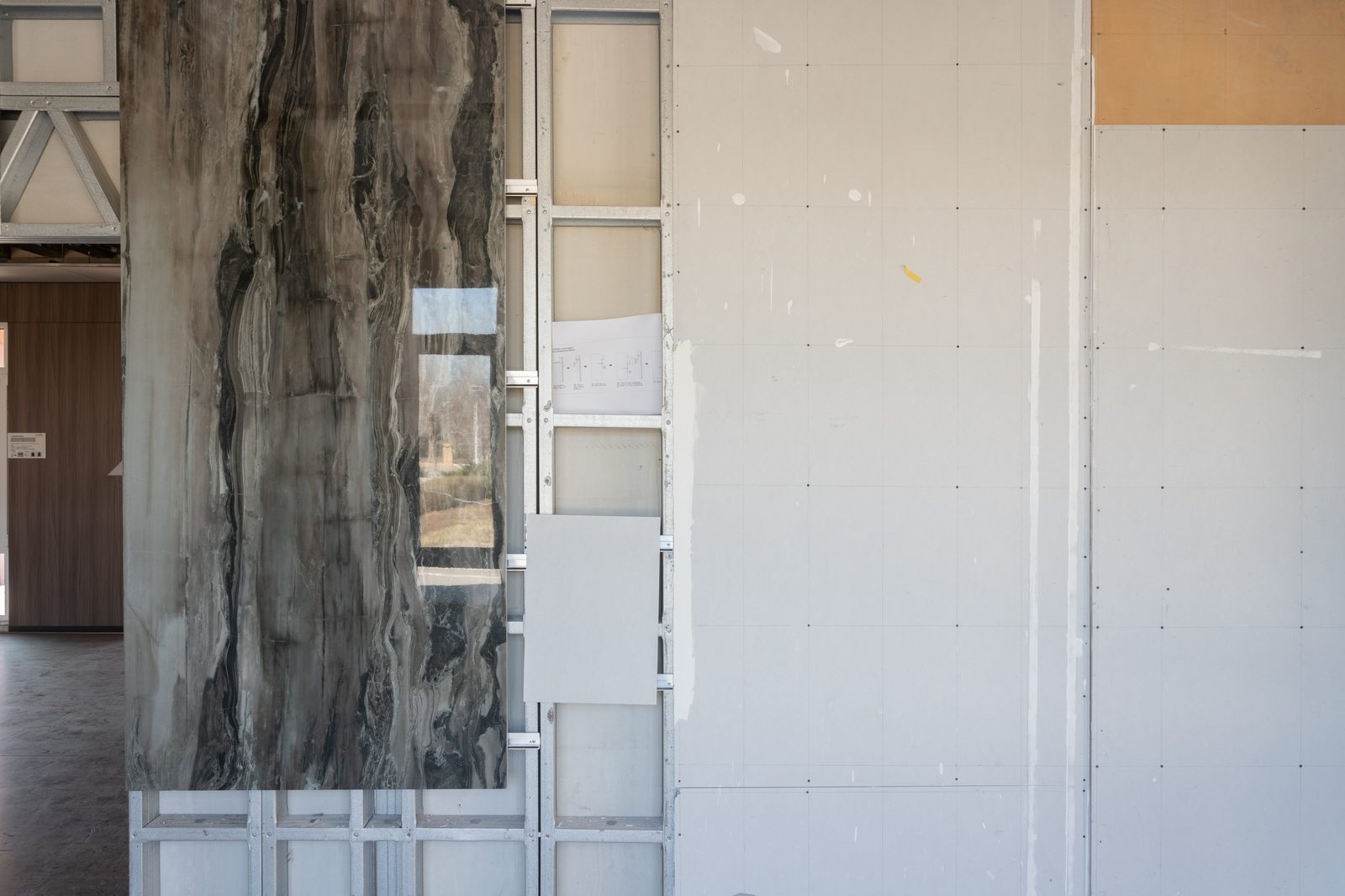
Swapping the substrate fixes the substrate term. It does not fix the wall. Five details decide whether the change is worth anything:
- Give the assembly a drying path. A drained, ventilated cavity or vented service void. A lining sealed on both faces has nowhere for vapour to go.
- Vapour control on the warm side only. Two barriers — one each side of a cavity — is the classic way to build a wall that traps its own moisture.
- Treat cut edges as the weak point. Seal every site-cut edge before it is closed in, and prime the back face against a wet zone. Most skipped step on wet-area jobs.
- Break the capillary path at the floor. Keep the board off a slab or wet floor on a continuous bead or base detail.
- Detail movement openly. A 3–5 mm gap closed with flexible sealant, not rigid fill. Corrosion-resistant fixings at the required centres.
| Zone | Substrate | Still required |
|---|---|---|
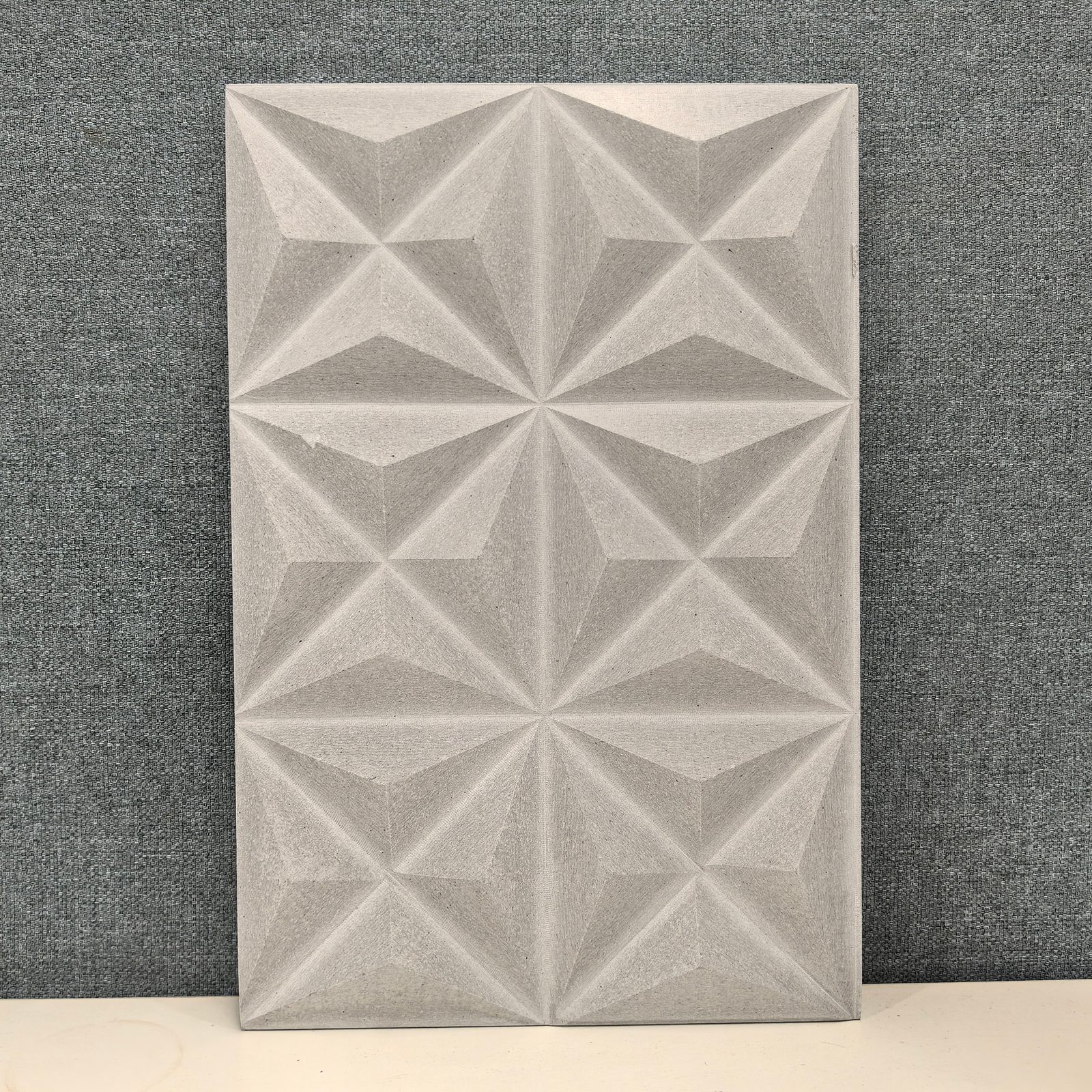
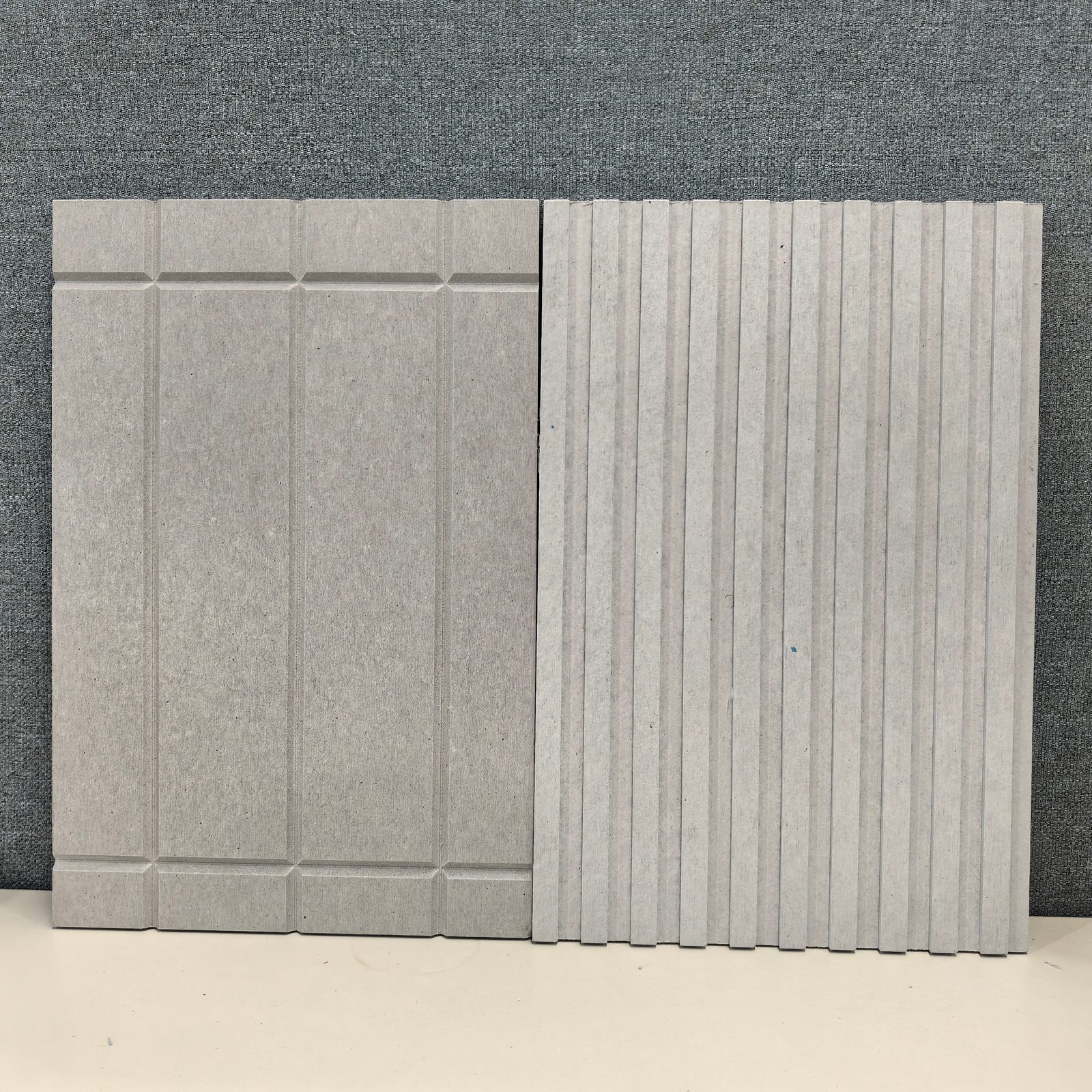
| Bathroom dry zone | Low-density fiber cement board, 8–9 mm; a decorative board or wall panel where no tile is wanted | Sealed edges, primed back, mechanical extract |
| Shower wet zone | Calcium silicate board or denser fiber cement board | Tanking or membrane, sealed corners, drained tray joint |
| Basement / retaining wall | Calcium silicate board on a drained cavity | Drainage plane and outlet; never direct to a damp wall |
| Kitchen splashback | Fiber cement board, or a decorative board for a stone-look face | Sealed joint to worktop; steam path to the extractor |
| Exterior soffit | Exterior-grade fiber cement board | Sealed edges, coated face, grade matched to freeze-thaw |
FAQ: Moisture Resistant Panels
Is a moisture resistant panel the same as a waterproof one?
No. Moisture resistance means the panel tolerates humidity, condensation and occasional wetting without swelling or feeding mould. Waterproof means the assembly keeps bulk water out, which is the job of the membrane, the sealant and the drainage plane. A fiber cement board holds its dimensions in humid service, with wet expansion of 0.25% or less and dry shrinkage of 0.15% or less, but it does not replace tanking in a shower.
Why do wood-based panels fail in wet rooms and basements?
Because they are hygroscopic. OSB, MDF and plywood take water into the fibre and glue line and swell at the edges, and never fully recover their thickness. Strength and fixing grip are lost irreversibly, and the cellulose is food for mould. In a closed cavity the panel often cannot dry at all, so a slow vapour leak does what a flood would, just later.
Will mould grow on an inorganic fiber cement board?
The board cannot feed it. Mould needs spores, food, moisture and a suitable temperature; the food is the term you can remove. Fiber cement board and calcium silicate board are inorganic through their full thickness, with no cellulose or starch for mycelium to colonise. Growth can still appear on dust or soap scum on any surface — a cleaning issue, not a substrate failure.
How do I check a moisture resistant panel claim before specifying?
Ask which swelling test and immersion duration the number comes from, what the water absorption figure is, what the density is, and whether the mould result covers the board or a coated system. Our low-density board publishes wet expansion 0.25% or less, dry shrinkage 0.15% or less, no delamination or mould after 30 days of immersion, density 0.65–0.85 g/cm³, flexural strength ≥10 MPa and screw-holding ≥1,200 N.
Where should a moisture resistant panel not be used?
Not as the sole protection in a pool basin or anywhere the panel sits in standing water; not as an exposed exterior face in severe freeze-thaw without the correct grade and coating; and not where the design relies on the board as a vapour barrier. Use a denser board or a calcium silicate board instead, and keep the waterproofing and drainage details intact.