
Abstract
Few building types punish a wall panel specification harder than an airport. Aviation hubs combine strict fire codes, 24/7 operations that rule out disruptive re-work, enormous runs of service ductwork overhead, and public concourses where thousands of passengers pass within arm's reach of the lining every day. Between 2021 and 2023, Zhongjing boards were specified on five separate projects at Guangzhou Baiyun International Airport — one of China's busiest international gateways — covering approximately 138,000 m⊃ of fiber cement board and related inorganic panels.
This case study breaks the portfolio down project by project: what was installed, why that specific board family was chosen for each duty, and what the pattern tells specifiers working on airports, logistics terminals and other transport infrastructure anywhere in the world. It is the second in our series of five landmark project studies, alongside the Beijing 2022 Winter Olympic ski jump case study.
Key Takeaways
- One airport, five projects, one material logic. Fire-rated walls, fire partitions, smoke-duct enclosures and exterior cladding were all solved with variants of the same A1 inorganic board family — simplifying procurement, certification review and site QA across the whole campus.
- Fire rating drove the specification, not aesthetics. The largest single package — 50,000 m⊃ of fire-rated crystal board — exists because the cargo logistics facility required 4-hour fire-rated walls, a rating that wood-based panels cannot reach and that gypsum-based systems struggle to hold at practical thicknesses.
- Overhead ductwork is a hidden volume driver. The single largest area in the portfolio — 70,000 m⊃ of 9 mm fire board — went into smoke exhaust and smoke-control duct linings for the Phase 3 expansion, an application most specifiers underestimate when they budget board quantities for transport projects.
- The same family serves inside and out. 13,000 m⊃ of through-colour fiber cement board was installed on exterior walls, proving the system range: low-density grades inside for wall panel and decorative board duty, denser through-colour grades outside for weather exposure.
The Five-Project Portfolio at a Glance
| # | Project | Product | Application | Volume | Year |
|---|---|---|---|---|---|
| 1 | Sinotrans Air Cargo Logistics Facility | Fire-Rated Crystal Board | 4-hour fire-rated walls | 50,000 m⊃ | 2021 |
| 2 | East & West Pier Corridors | TaiCom Composite Wall Board (100 mm) | Fire partitions | 5,000 m⊃ | 2023 |
| 3 | Phase 3 Expansion | Weibao Fire Board (9 mm) | Smoke exhaust & smoke-control duct linings | 70,000 m⊃ | 2023 |
| 4 | China Southern Airlines Dormitory | Through-Colour Fiber Cement Board | Exterior walls | 13,000 m⊃ | 2021 |
| 5 | Terminal Interior Linings | Xiubi Decorative Board | Interior wall finishes | — | — |
Together the five packages total ≈138,000 m⊃ — 50,000 + 5,000 + 70,000 + 13,000 across the four quantified contracts, plus terminal interior lining work. Each is documented in our Featured Projects library.
Why a Cargo Facility Needs 4-Hour Fire-Rated Walls
The 2021 Sinotrans air-cargo facility at Baiyun Airport stores high-value freight directly beside one of the country's most operationally critical airfields. Insurance and aviation-safety reviews for facilities of this class commonly demand compartment walls rated to four hours — long enough for the fire service to control a deep-seated cargo fire without it spreading across fire sections.
Reaching four hours with a practical wall build-up requires a substrate with three properties at once:
- A1 non-combustibility. The board itself must contribute zero fuel. The crystal board specified here is classified A1 under GB 8624-2012 and EN 13501-1: it does not ignite, melt or drip at 1,000°C, and its smoke toxicity is rated AQ1 (the safe class) rather than merely quasi-safe.
- Dimensional stability under fire exposure. Boards that shrink or crack at high temperature open paths for flame and hot gases. An autoclaved fiber cement board keeps its geometry, which is what allows multi-layer systems to hold their rating for the full test duration.
- Strength at modest thickness. Lining both faces of a stud wall doubles board area; a board that stays flat and intact at 9–12 mm keeps the build-up slim, protecting lettable floor area inside the fire compartments.
Wood-based fire boards were ruled out at code review — they are at best Class B1 (flammability-retarded, not non-combustible) and char with toxic smoke. Gypsum-based boards sag and lose integrity earlier in a four-hour curve. The same reasoning, at the same code review table, is why fiber cement board outperforms gypsum board on airport and logistics specifications generally.
Smoke-Duct Linings: The 70,000 m⊃ Nobody Budgets For
The Phase 3 expansion package is the largest in the portfolio, and almost all of it is invisible to passengers: 70,000 m⊃ of 9 mm Weibao fire board wrapping smoke exhaust and smoke-control ductwork. Smoke-management ducts are life-safety equipment. During a fire they must keep pulling smoke out of the terminal while everything around them burns, so their enclosures must themselves be fire-rated assemblies.
A fiber cement board lining is the natural enclosure material for three reasons:
- Non-combustible by chemistry, not by coating. The A1 rating is intrinsic to the inorganic matrix — there is no fire-retardant treatment to wash out or age, an important point over a duct system's decades-long service life.
- Light enough to hang overhead. A 9 mm autoclaved panel adds only about 8 kg/m⊃. Multiplied across hundreds of linear meters of duct, the difference between an 8 kg/m⊃ and a 15+ kg/m⊃ enclosure decides whether the existing duct hangers can carry the lining without structural reinforcement.
- Clean to install in live-terminal conditions. Boards score and snap cleanly, generating minimal dust — a real constraint when ductwork is being lined adjacent to operating terminal zones.
For specifiers, the planning lesson is simple: when you estimate inorganic board volumes for a transport hub, add the ductwork early. Overhead fire protection routinely adds tens of thousands of square meters that never appear on architectural elevation drawings. Our fiber cement board thickness guide maps which grades suit duct-enclosure, partition and facade duty.
Fire Partitions in the Piers, Decorative Finishes in the Terminal
The east and west pier corridor works (2023, 5,000 m⊃) used 100 mm TaiCom composite wall board systems as fire partitions between passenger corridors and back-of-house zones. A composite wall panel system ships as a factory-made panel: the fiber cement faces and the core arrive as one unit, so corridor walls go up quickly, straight and with predictable acoustics — valuable in pier geometry, where every linear meter of wall sits within meters of aircraft stands and service corridors.
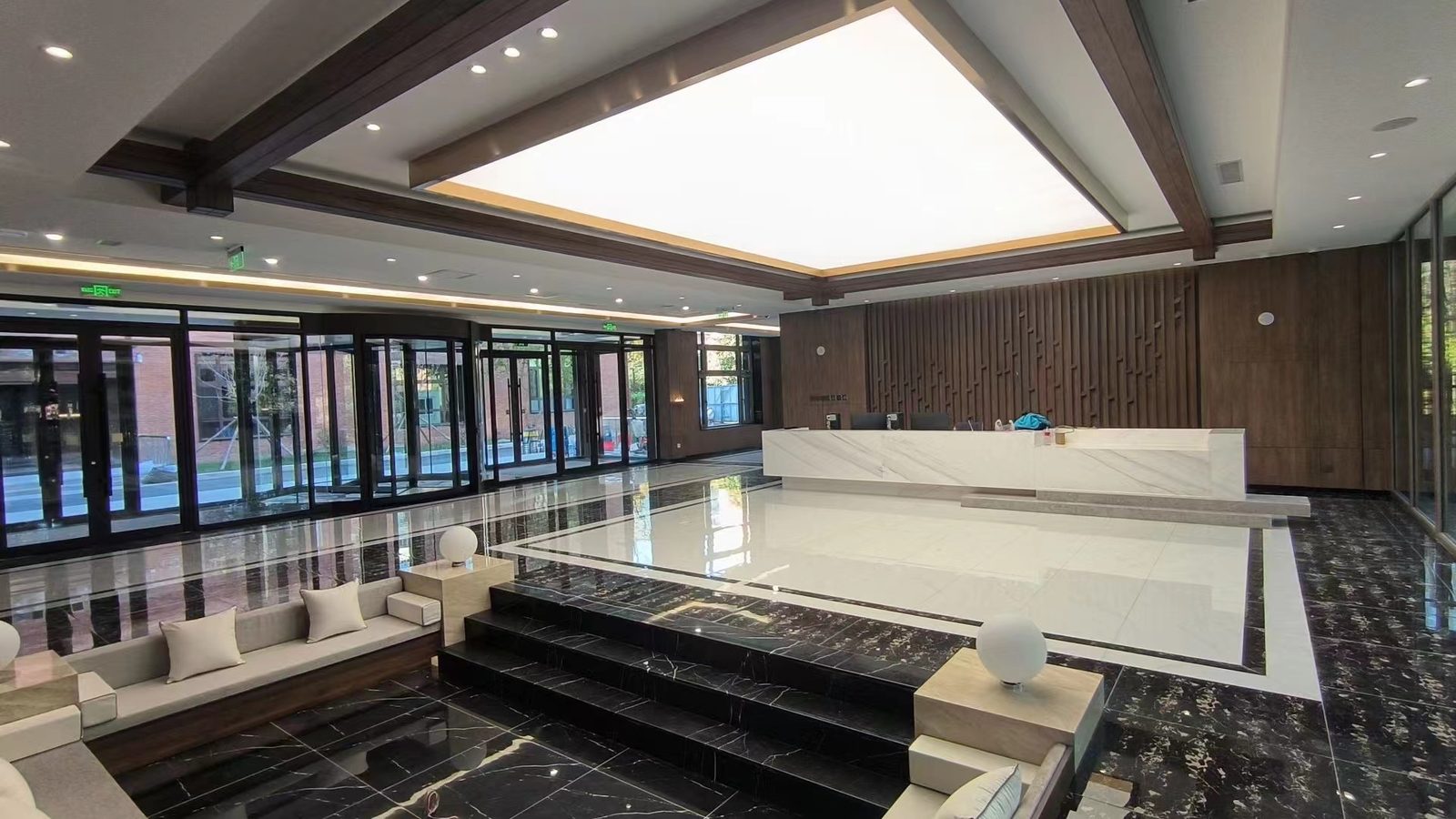
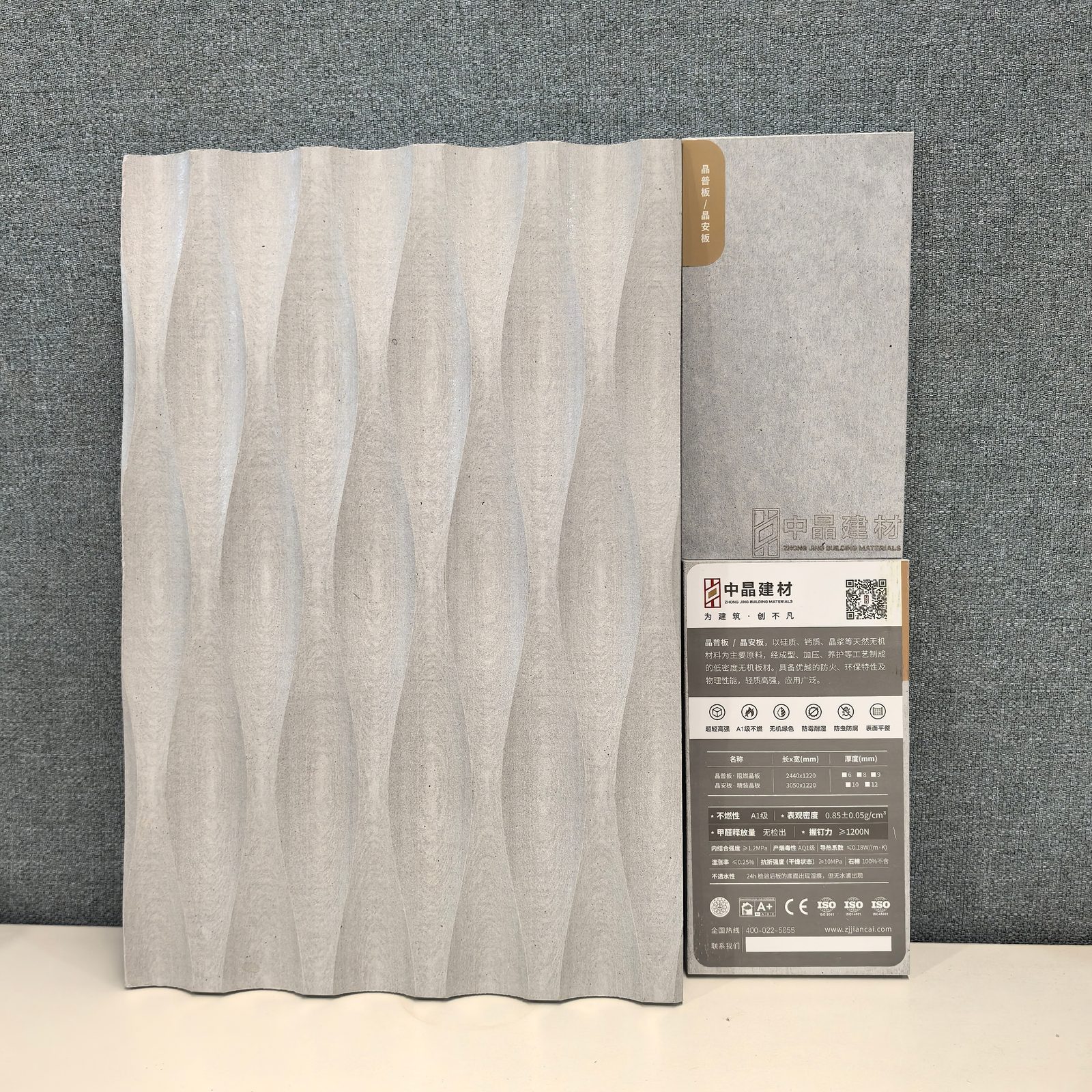
Inside the terminal itself, the fifth package used Xiubi decorative board for interior wall finishes. Airport interiors demand an unusual combination from a decorative board: it must look finished straight off the panel, take impact from luggage trolleys, wipe clean for daily deep-cleaning regimes, and still hold an A1 fire class in a public assembly space. A pre-finished, factory-decorated inorganic panel answers all four at once — which is also why pre-finished decorative board ranges keep appearing in transport and hospitality specifications, from marble-effect to wood-grain surfaces.
The pairing principle repeats here just as it did at the Olympic ski jump venue: fiber cement board for structural fire duty, calcium silicate board and pre-finished decorative panels for lining and finish duty. Both families are A1, both are autoclaved inorganics, both share HS Code 681182 and ship in the same container — a supply-chain detail that mattered when the five contracts ran in parallel across one airport campus. For a deeper comparison of the two board families, see calcium silicate board vs gypsum board.
Exterior Walls That Weather the Subtropics
The China Southern Airlines dormitory package (2021, 13,000 m⊃) moved the same material family outdoors: through-colour fiber cement board on exterior walls. Guangzhou's climate is humid subtropical — summer typhoon rain, high year-round humidity, and freeze-thaw is replaced by mold pressure as the durability challenge. The board selection held up on three counts:
- Moisture stability: wet swelling ≤0.25% and dry shrinkage ≤0.15%, so the facade line stays flat season after season; the inorganic matrix gives mold no nutrient to grow on.
- Freeze-thaw reserve: 100 freeze-thaw cycles retain ≥80% of bending strength — relevant for higher-altitude or northern campuses supplied from the same product family.
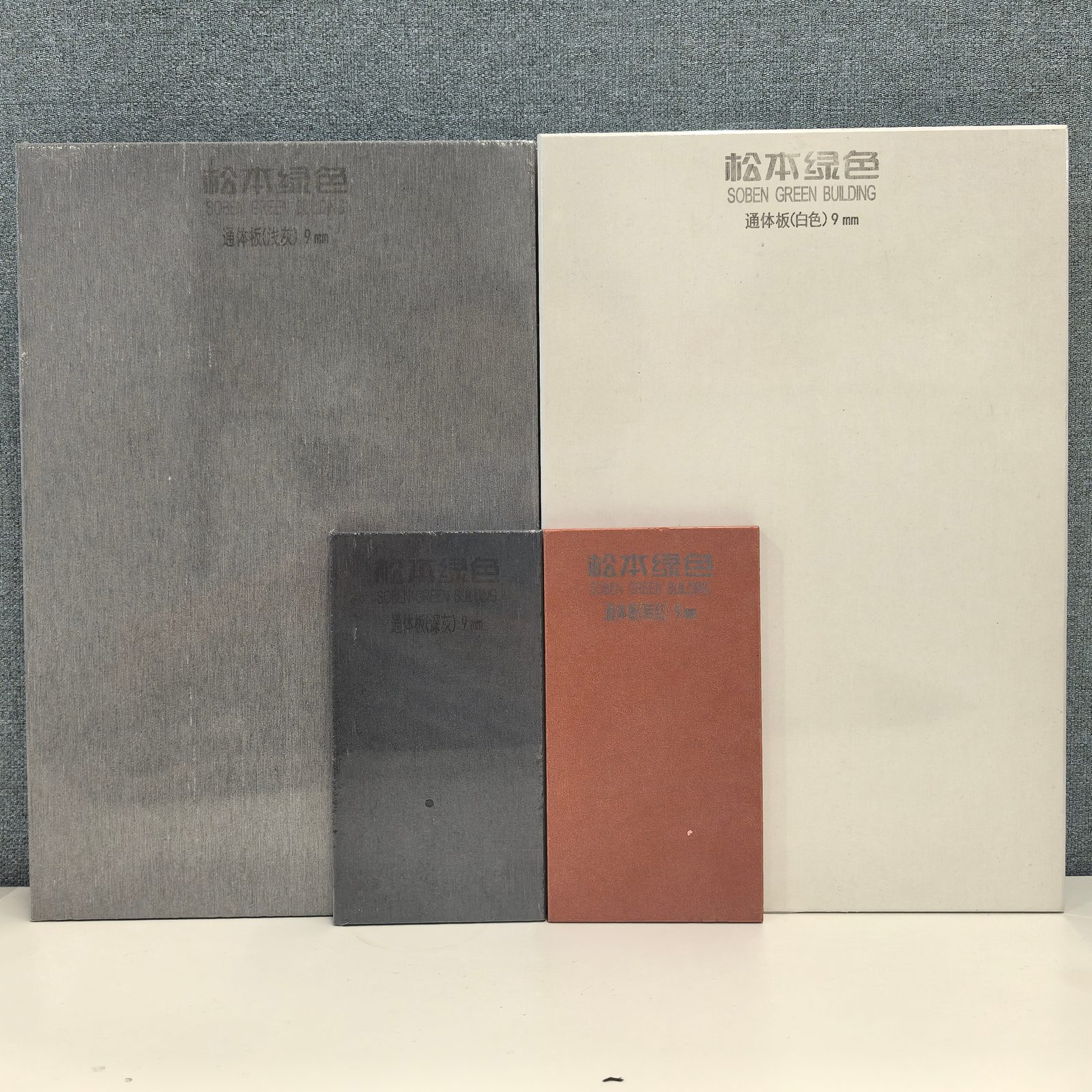
- Through-colour finish: the color runs through the panel thickness, so edges, cut-outs and minor abrasions do not expose a different-colored core — the appearance survives the inevitable service penetrations of an airport support building.
Exterior wall panel detailing for this class of building — fixings, joints, openings and ventilation — is covered in our external facade cladding guide.
Lessons for Specifiers on Transport Infrastructure
- Write one board family into the spec, then assign grades by duty. Five contracts, one A1 inorganic family, four different duties. That structure compressed certification review (one certificate set) and site approvals, and it kept a single replacement path open for the operator's 20-year maintenance plan.
- Count the ductwork before the architecture. Smoke-duct linings were the largest volume in the portfolio. If your board take-off only counts partitions and ceilings, you will under-order a transport project by a wide margin.
- Match density to exposure, not to habit. Interior wall panel and decorative board duty takes the lighter grades and wins on install speed; fire-rated walls, duct enclosures and facades take denser grades. The failure mode to avoid is specifying one thickness and density for everything "to keep it simple".
- Ask for the system, not the sheet. The 4-hour wall and the duct enclosure are tested assemblies — board, stud, insulation and fixings together. Buy the certificate with the system, exactly as the Baiyun contracts did.
Spec Snapshot — Guangzhou Baiyun Airport Portfolio
- Scope: 5 projects · ≈138,000 m⊃ supplied · 2021–2023
- Products: Fire-Rated Crystal Board · TaiCom Composite Wall Board 100 mm · Weibao Fire Board 9 mm · Through-Colour Fiber Cement Board · Xiubi Decorative Board
- Applications: 4-hour fire-rated walls · fire partitions · smoke exhaust & smoke-control duct linings · exterior walls · interior decorative linings
- Fire classification: A1 non-combustible (GB 8624-2012 & EN 13501-1), smoke toxicity AQ1
- Certification set: CE, A1, French A+, REACH, ENF (formaldehyde not detected)
- HS Code: 681182
FAQ
How much fiber cement board was supplied to Guangzhou Baiyun Airport?
Approximately 138,000 m⊃ across five projects between 2021 and 2023: 50,000 m⊃ of fire-rated crystal board for 4-hour fire walls at the air-cargo logistics facility, 5,000 m⊃ of 100 mm TaiCom composite wall panel for pier fire partitions, 70,000 m⊃ of 9 mm fire board for smoke-duct linings in the Phase 3 expansion, and 13,000 m⊃ of through-colour fiber cement board for the China Southern Airlines dormitory exterior, plus terminal interior decorative linings.
What board achieves a 4-hour fire-rated wall?
A practical 4-hour wall is a multi-layer A1 board lining on a steel stud frame with insulation. The substrate must be genuinely non-combustible and dimensionally stable at high temperature; A1-classified fiber cement board meets both, while wood-based panels top out at Class B1 and gypsum-based boards lose integrity earlier in the four-hour curve. System rating always depends on the complete tested assembly.
Why is fiber cement board used for smoke exhaust duct linings at airports?
Smoke-control ducts are life-safety systems that must keep working while surrounding structure burns. A 9 mm fiber cement board enclosure is non-combustible by chemistry, adds only about 8 kg/m⊃ so existing duct hangers can carry it, and installs with minimal dust — important next to live terminal zones. At Baiyun's Phase 3 expansion alone, 70,000 m⊃ of duct lining was installed.
Is fiber cement board suitable for airport exterior walls?
Yes, with a denser through-colour grade: 13,000 m⊃ of through-colour fiber cement board clads the China Southern Airlines dormitory at Baiyun. The grade is chosen for wet swelling ≤0.25%, ≥80% strength retention after 100 freeze-thaw cycles, and a color that runs through the panel so cut edges and abrasions stay visually consistent.
Fiber cement board vs calcium silicate board: which is used in airport projects?
Both. They share A1 inorganic chemistry but split the duties: fiber cement board takes fire-rated walls, impact zones and exteriors; calcium silicate board takes partitions, ceilings and finish linings where low weight and smooth surfaces win. The Baiyun portfolio used both families in parallel — both under HS Code 681182, shipped in the same containers.
References
- Standardization Administration of China. (2012). GB 8624-2012: Classification for burning behavior of building materials and products. Beijing: SAC.
- European Committee for Standardization. (2018). EN 13501-1: Fire classification of construction products and building elements. Brussels: CEN.
- European Committee for Standardization. (2021). EN 12467: Fibre-cement flat sheets — Product specification and test methods. Brussels: CEN.
- ASTM International. (2022). ASTM C1186-22: Standard Specification for Flat Fiber-Cement Sheets. West Conshohocken, PA: ASTM.
- Civil Aviation Administration of China. Code for fire protection design of civil airport terminals (GB 51236). Beijing: CAAC.
Last reviewed and updated: September 2026. Author: Zhongjing Building Materials Technical Team. The projects described are five supply contracts within the Guangzhou Baiyun International Airport campus (2021–2023). Project locations, product specifications and application areas are documented in our public project library; specific contractual details remain confidential. For enquiries on airport, logistics or transport-infrastructure fiber cement board and calcium silicate board supply (HS Code 681182), contact [email protected].